The Accelerated Research for Transition, or ART, program is the Department’s current public-facing transition pathway for moving promising SBIR/STTR Phase II technologies toward Phase III outcomes, including production, operational use, and sustainment. Publicly, ART is presented as a sponsor-driven program built to help mature small-business innovations cross the gap between development and real-world adoption. The official ART materials emphasize transition planning, sponsor commitment, acquisition alignment, and a structured path into later-stage use.
ART matters because it sits inside a larger Defense innovation system managed by the Office for Small Business Innovation, the office that oversees the Defense SBIR/STTR enterprise at the department level. The official office site says it serves as the Department’s point of contact for Congress, the Small Business Administration, the Government Accountability Office, and the interagency SBIR/STTR community, while also seeking technology partnership opportunities across the Department and with other federal agencies.
For companies trying to understand where to engage, the key distinction is this: the Office for Small Business Innovation runs the enterprise layer of Defense SBIR/STTR, including policy, portal infrastructure, education, due diligence support, and ART. The military departments and defense agencies then run much of the mission-specific execution layer, including many topics, customer relationships, and award activities. That division of labor is visible in the office leadership descriptions, the DSIP guidance, and the component program sites.
What is the ART program?
ART is the Department’s current SBIR/STTR transition program for helping high-performing Phase II projects move toward Phase III and operational deployment. The April 2026 reauthorization announcement says the Department relaunched its SBIR/STTR activity with ART as part of a broader push toward measurable innovation outcomes, faster transition, and alignment with current operational demand signals. The same release says the office would resume its established schedule of releasing new topics on the first Wednesday of every month.
Publicly, ART offers multiple transition pathways. The official ART materials describe a Technology Transition Agreement path in which the sponsor commits to transition the technology, identifies acquisition and integration funding, and documents the transition plan through a formal agreement. Public ART materials also present the program as a vehicle for additional non-dilutive support aimed at bridging the valley of death between prototype development and fielded capability.
In plain terms, ART is not positioned as a general commercialization coaching program. It is presented as a sponsor-backed transition mechanism. That means a strong technical project alone is not enough. The public-facing materials consistently frame ART as requiring an operational demand signal, a sponsoring customer, and an identified path into acquisition, integration, or follow-on use.
What did ART replace?
Based on the Department’s own public materials, ART is the successor to the earlier OTST transition pilot, the OSD Transitions SBIR/STTR Technology program. Public OTST materials describe a program that matched funding 1:1 with sponsors for new or ongoing Phase II projects, used Technology Transition Agreements, offered centralized contracting support, and aimed to bridge the valley of death into programs of record and Phase III outcomes. Public ART materials describe substantially the same transition logic and many of the same structural features.
That makes the most accurate public description of ART this: ART is a successor and refresh of OTST, not a wholly unrelated program. The public documents do not frame it as an entirely new category of funding. Instead, they show continuity in transition mechanics, combined with a stronger 2026-era emphasis on speed, accountability, modernization alignment, and delivery into operational demand.
What does the Office for Small Business Innovation do?
The Office for Small Business Innovation is the department-level office that oversees the Defense SBIR/STTR enterprise. Its official site says it is housed under the Under Secretary for Research and Engineering structure and oversees the Defense SBIR/STTR programs. Its public-facing role includes being the point of contact for Congress, SBA, GAO, and the interagency SBIR/STTR community.
Operationally, the office appears to provide five major categories of services.
1. Program entry and opportunity discovery
The office runs the main public entry point into Defense SBIR/STTR. Its program pages host the overall program overview, interactive guide, current and past funding opportunities, and the Defense SBIR/STTR Innovation Portal, or DSIP, which is the official proposal portal. The opportunities page explains that Defense issues three pre-scheduled SBIR/STTR BAA or CSO cycles each year, while annual BAAs give components additional flexibility to release topics throughout the fiscal year.
2. Proposal infrastructure and submission support
The office provides the shared proposal infrastructure through DSIP. Official guidance says all Defense SBIR/STTR proposals must be submitted electronically through DSIP and that companies must review both the department-wide BAA or CSO document and the component-specific instructions for the topic they want to pursue. The same guidance says the Department does not accept unsolicited proposals.
3. Due diligence, compliance, and risk review
The office provides common due diligence guidance for the enterprise. Its due-diligence materials say every proposal submitted to a Defense SBIR/STTR program is subject to a security-based risk review tied to foreign-country-of-concern risk. The deputy director’s official biography also says he leads the development of SBIR/STTR due-diligence policies and procedures across the services and components, which is a strong sign the office is operating as a common governance layer rather than just a website owner.
4. Data rights and technology protection support
The office also provides practical education on data rights and technology protection. Its data-rights materials explain recent changes in the protection framework and note that after the SBIR/STTR protection period the government receives perpetual government-purpose rights rather than unlimited rights. Its technology-protection materials point users to CUI training, marking guides, and a sample marking guide for CUI and SBIR data rights.
5. Outreach and transition support
The office publicly offers speaker requests and outreach support, and it runs the department-level transition lane through ART. Its home page includes a speaker-request path, while the ART program gives the office a formal mechanism to help mature Phase II projects move into acquisition-aligned outcomes when there is sponsor demand and a defined transition strategy.
How companies access these services
For companies new to Defense SBIR/STTR, the official access path is straightforward. Start at the Office for Small Business Innovation site, review the program materials, and move into DSIP to browse topics and submission requirements. The opportunities page says companies should register early once they identify a proposal opportunity and must read both the BAA or CSO and the corresponding component-specific instructions.
For technical questions, the process changes depending on where the solicitation is in its lifecycle. During the pre-release period, the opportunities page says topic authors’ names and contact information are published and companies are encouraged to communicate directly with them. Once the solicitation enters the open period, direct communication is no longer permitted and questions must go through DSIP Topic Q&A, where questions and answers are posted electronically for general viewing.
For system support, companies should use DSIP support, but official guidance draws a clear line around what that support can and cannot do. The DSIP support document says DSIP support cannot edit proposals, cannot resolve technical topic questions, and cannot override component-specific instructions, which supersede what appears in DSIP if there is any conflict.
After a BAA closes, the contact path shifts to the originating component. The support document says companies should use the point of contact listed in the component-specific instructions for post-closing matters. That reinforces the broader pattern: the Office for Small Business Innovation runs the shared front door and rules layer, while the component office becomes the practical counterparty once a company is working a specific topic or award.
For ART specifically, access is not described as an open pool of general transition money. Public materials frame it as a sponsor-backed pathway. Companies access ART by building a credible transition case tied to a real government demand signal, a sponsoring customer, and an acquisition-aligned plan.
How this office compares with Army, Navy, AFWERX, and DARPA
The easiest way to understand the Office for Small Business Innovation is to compare it with the service and agency offices companies usually encounter first.
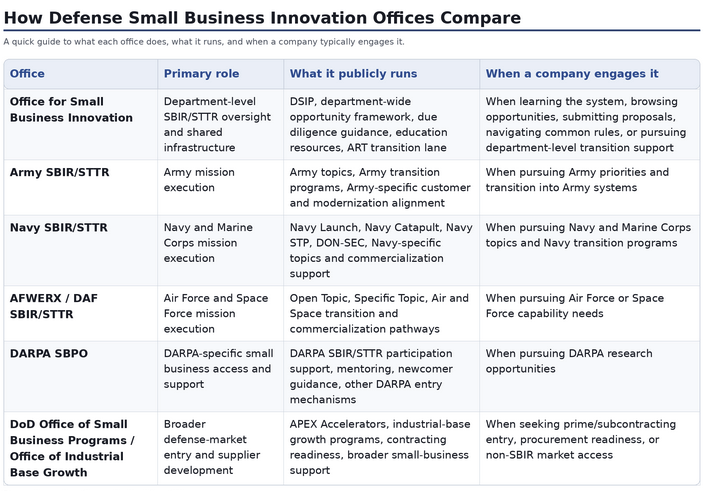
The Army program says it identifies emerging technologies to meet critical Army priorities and transitions solutions into Army systems for Soldiers. The Navy program publicly lists Navy Catapult, Navy Launch, the Navy SBIR Transition Program, and DON-SEC as part of its offerings. AFWERX says its SBIR/STTR mission is to fund emerging technologies for Air Force and Space Force capabilities and broaden access to disruptive innovation. DARPA’s Small Business Programs Office says it helps firms understand DARPA’s mission, culture, policies, and procedures so they can participate in SBIR, STTR, seedlings, and explorations.
The practical takeaway is simple: the Office for Small Business Innovation is the enterprise headquarters layer; the component offices are the mission-execution layer. Companies usually need both. They use the central office for structure, access, and common rules, and they work with a component office for actual mission pull, topic ownership, and downstream transition activity.
How this office differs from the broader DoD small-business ecosystem
The Office for Small Business Innovation is also different from the Office of Small Business Programs and the broader Office of Industrial Base Growth. The official defense small-business site says the Office of Industrial Base Growth is the umbrella organization focused on expanding and strengthening the defense industrial base through vendor growth and supplier maturity, and it says the Office of Small Business Programs remains a vital part of that broader organization.
That broader small-business ecosystem is focused on market entry, supplier development, and contracting readiness, not just innovation awards. The official “Guide to Working with DoD” says APEX Accelerators help small businesses compete for and execute contracts with DoD and other federal agencies, and that most APEX services are free. The military-departments-and-defense-agencies page says small-business professionals inside those offices help companies understand mission requirements and identify prime-contracting and subcontracting requirements.
So the distinction for clients is this: if the goal is SBIR/STTR entry, proposal submission, due diligence support, or transition through ART, the Office for Small Business Innovation is the more relevant office. If the goal is broader contracting access, industrial-base entry, supplier development, or procurement readiness, the Office of Small Business Programs, APEX Accelerators, or a component small-business office may be the better first stop.
Why this matters for small businesses
For early stage and growth stage companies, this structure matters because Defense innovation is not a one-office market. Firms that only understand the component topic but not the enterprise rules can get stuck on submission mechanics, due diligence, or transition strategy. Firms that only understand the central process but never build a sponsor-backed path inside a service or agency often struggle to convert technical progress into actual adoption. The public structure of ART makes that especially clear: transition now depends heavily on sponsor commitment and acquisition alignment, not just a promising prototype.
The strongest companies will treat the Office for Small Business Innovation as the system navigator and standards setter, while treating the relevant component office as the customer and transition owner. That is the most practical way to understand how Defense SBIR/STTR works today based on the official public record.
FAQ
What is the ART program?
ART is the current Defense SBIR/STTR transition program designed to move strong Phase II efforts toward Phase III outcomes such as production, operation, and sustainment. Public materials describe it as sponsor-driven and aligned to operational demand.
What did the ART program replace?
ART replaced the earlier OTST transition pilot. Public OTST and ART materials show substantial continuity in purpose and transition structure, including sponsor-backed pathways and Technology Transition Agreements.
What does the Office for Small Business Innovation do?
It oversees the Defense SBIR/STTR enterprise, runs the shared portal and program framework, supports due diligence and policy consistency across components, provides education on data rights and technology protection, and operates the ART transition lane.
How do companies access the office’s services?
Companies start through the office’s public site and DSIP, review the department-wide and component-specific solicitation instructions, use topic-author contact or DSIP Topic Q&A depending on the solicitation phase, and shift to the component office after the BAA closes.
Is this office the same as Army, Navy, AFWERX, or DARPA SBIR offices?
No. The Office for Small Business Innovation runs the department-level SBIR/STTR layer, while Army, Navy, AFWERX, and DARPA run their own mission-specific small-business execution channels and transition programs.
Is this office the same as the DoD Office of Small Business Programs?
No. The Office of Small Business Programs and the Office of Industrial Base Growth focus more broadly on defense-market entry, supplier development, and contracting support, while the Office for Small Business Innovation is focused on the Defense SBIR/STTR innovation pipeline and transition support.
If you want to win government contracts and grow your business, set up a time to chat with our team and see how we can help you win more