Slack’s FedRAMP Support Data Change: What Business Owners Need to Know Now
Slack has begun asking some workspace owners to make an important compliance decision: whether their organization’s Slack customer support data must remain stored and managed inside a FedRAMP authorized system.
For business owners, this is more than a technical notice. It is a reminder that data shared with a vendor’s support team can create compliance risk, even when the primary software product is already approved or trusted for day-to-day use.
Slack’s public FAQ says organizations that require support data to remain within a FedRAMP boundary must submit a declaration by August 16, 2026. Slack also states that it is moving customer support data into commercial support infrastructure that is not within a FedRAMP authorized boundary, as part of its plan to enhance and standardize the Slack customer experience.
Key Takeaways
Business owners should understand five things:
This change is about Slack support data, not normal Slack workspace data.
Support data can include text, messages, files, images, and screenshots shared with Slack Support.
A support ticket can accidentally contain sensitive government, customer, security, or contract information.
Organizations working with federal agencies or federal contractors should review FedRAMP, CUI, FCI, DFARS, and NIST SP 800-171 obligations.
Slack says only the Primary Owner can submit or change the FedRAMP declaration, and each workspace or Enterprise organization must be evaluated separately.
What Is Changing?
Slack says it is moving customer support data into commercial support infrastructure used by Salesforce to host support data. Slack states that this infrastructure is not within a FedRAMP authorized boundary, though it continues to follow Slack’s trust requirements and security controls.
Slack explains that this change is connected to future Success Plans for Slack, which are expected to provide enhanced customer success resources, personalized guidance, and expedited support experiences.
Organizations have two paths:
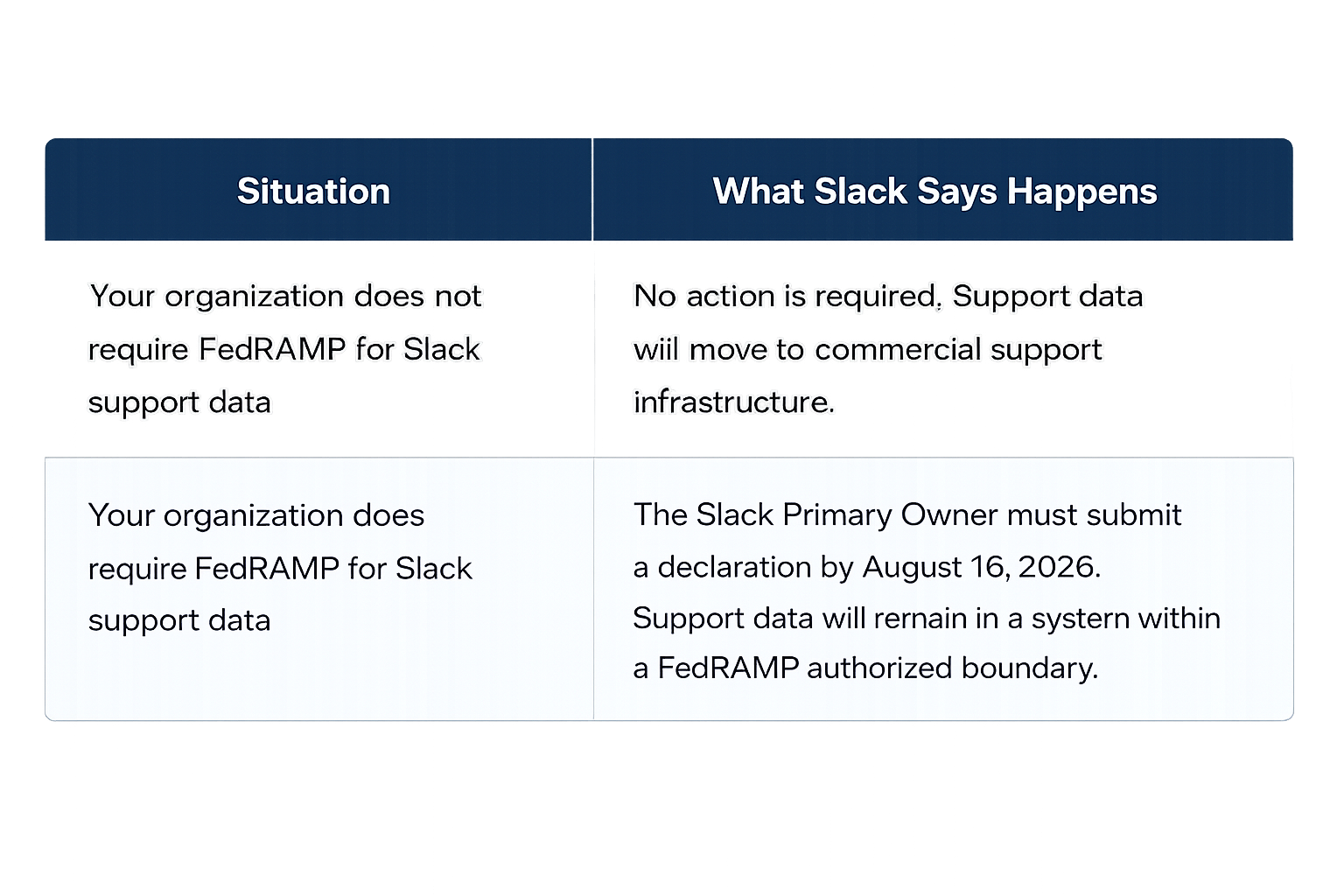
Slack also notes that organizations requiring FedRAMP may experience delays in future support innovations while Slack ensures compliance with FedRAMP requirements.
What Counts as Slack Support Data?
Slack defines support data as information shared or generated to resolve a service request through support tickets or chats submitted through Slack’s support process. This can include:
Text
Messages
Files
Images
Screenshots
Communications between your team and Slack Support
Slack states that this change does not affect Slack workspace customer data, such as normal Slack messages inside your workspace.
That distinction matters. Your workspace data and your support data may not be handled in the same compliance environment.
Why Business Owners Should Pay Attention
Many businesses think of compliance in terms of the main system: the CRM, the document repository, the accounting platform, the messaging workspace, or the database.
But support systems are also data systems.
A routine support case can include:
Screenshots of internal systems
User lists or email addresses
Identity and access management settings
SSO, SAML, or SCIM configuration details
Workflow errors
Logs and diagnostic files
Customer information
Federal project names
Contract references
Security incident details
Controlled Unclassified Information, also known as CUI
Federal Contract Information, also known as FCI
Covered defense information
PII or PHI
The risk is simple: when sensitive information is copied into a support ticket, the vendor’s support environment may become part of your compliance boundary.
What Is FedRAMP?
FedRAMP is the Federal Risk and Authorization Management Program. It provides a standardized approach to security assessment, authorization, and continuous monitoring for cloud products and services used by the federal government. Slack’s FAQ states that FedRAMP compliance is mandatory for U.S. government agencies and may also be necessary for companies that work with them and handle government data in a cloud environment.
FedRAMP’s own scope guidance makes an important point: FedRAMP does not apply to every use of an internet-based service. A single cloud service can be in scope or out of scope depending on how it is used, and the agency use case matters more than the name of the service itself.
When Can Messaging and Support Tools Become FedRAMP-Relevant?
FedRAMP’s scope guidance gives examples involving messaging and communication platforms, including Slack. It says sensitive messaging and communication use cases are in scope when agency teams use these platforms for internal or cross-agency work that processes and stores sensitive federal information with trusted access and centralized control.
The same guidance says non-sensitive messaging and communication may be out of scope when the use is for public collaboration, public communication, or non-sensitive coordination.
This is the practical lesson for business owners:
FedRAMP is not only about which tool you use. It is about what information enters the tool and how that information is used, stored, accessed, and controlled.
Why Federal Contractors Should Review This Carefully
Federal contractors and subcontractors should pay special attention because requirements may flow down through contracts.
The Federal Acquisition Regulation defines Federal Contract Information as non-public information provided by or generated for the government under a contract to develop or deliver a product or service to the government. FAR 52.204-21 also defines a covered contractor information system as one that processes, stores, or transmits Federal Contract Information.
For DoD contractors, DFARS 252.204-7012 says that if a contractor uses an external cloud service provider to store, process, or transmit covered defense information in performance of the contract, the contractor must require and ensure that the provider meets security requirements equivalent to the FedRAMP Moderate baseline.
NIST SP 800-171 is also relevant because its requirements apply to nonfederal systems that process, store, or transmit CUI, or that provide protection for those components.
For business owners, the takeaway is straightforward:
If protected government-related data can enter a vendor support ticket, the support environment may need the same level of review as the core application.
The Practical Risk: Support Tickets Become a Side Door
Most businesses do not intentionally send regulated data to vendor support teams. The problem usually happens during troubleshooting.
An employee wants help quickly. They upload a screenshot. They paste an error message. They attach a log. They forward a customer issue. They share a workflow name or channel name. They include a user list so the vendor can reproduce the problem.
Each of those actions may be reasonable from a support perspective. But each one can also move sensitive data into a different system.
That is why Slack’s notice is important beyond Slack itself. It highlights a larger SaaS governance issue: support data is still business data.
What Business Owners Should Do Now
Business owners should not ignore this notice, especially if their organization supports government, defense, healthcare, public sector, critical infrastructure, or regulated commercial customers.
At a minimum, organizations should complete the following steps.
1. Identify Every Slack Workspace
List every Slack workspace and Enterprise organization your company owns or manages.
For each one, identify:
Slack Primary Owner
IT owner
Security owner
Legal or compliance contact
Contract owner
Business owner
Slack says only the Primary Owner can submit or change the FedRAMP declaration.
2. Review Your Customer and Contract Base
Determine whether your organization works with:
U.S. federal agencies
DoD customers
Prime contractors
Federal subcontractors
State or local agencies with federal data requirements
Healthcare or life sciences customers
Public safety customers
Critical infrastructure customers
Regulated commercial customers
3. Review Contract Clauses and Flowdowns
Search contracts, subcontracts, and vendor requirements for references to:
FedRAMP
FedRAMP Moderate
FedRAMP High
DoD Cloud Computing SRG
FAR 52.204-21
DFARS 252.204-7012
NIST SP 800-171
CMMC
Controlled Unclassified Information
Federal Contract Information
Covered defense information
PII
PHI
HIPAA
CJIS
ITAR
Export-controlled data
4. Map What Employees Send to Slack Support
Review whether employees may send Slack Support:
Screenshots
Log files
Diagnostic bundles
Exported files
User lists
Channel names
App integration details
Workflow screenshots
Identity or SSO settings
Security incident details
Government project names
Customer names
Contract information
5. Decide Whether Support Data Can Include Protected Information
Ask one direct question:
Could a Slack support ticket contain information that our contracts, customers, or compliance obligations require us to protect?
If the answer is yes, the organization should treat Slack support data as a compliance-relevant data flow.
6. Decide Whether to Submit the FedRAMP Declaration
Slack says organizations that require FedRAMP for support data must submit the declaration by August 16, 2026. Organizations that do not require FedRAMP do not need to take action.
This decision should not be made by the Slack admin alone. It should involve security, legal, compliance, and contracts.
7. Train Employees on Support Ticket Hygiene
Regardless of the declaration decision, employees should be trained to avoid placing sensitive information into vendor support systems unless approved.
Good support ticket hygiene includes:
Redacting screenshots
Removing customer names when not needed
Avoiding sensitive attachments
Minimizing pasted logs
Removing tokens, credentials, and IDs
Avoiding government project names unless necessary
Using approved escalation channels for regulated matters
8. Apply the Same Review to Other SaaS Vendors
This is not only a Slack issue.
Business owners should review support workflows for:
CRM platforms
HR systems
Accounting and finance systems
Identity providers
Project management tools
Ticketing systems
Cloud platforms
Analytics tools
AI tools
Collaboration platforms
Managed service providers
The larger question is: where does your data go when your team asks a vendor for help?
Practical Checklist for Business Owners
Use this checklist before deciding whether Slack support data should remain in a FedRAMP authorized system.
Slack Workspace Review
We identified every Slack workspace and Enterprise organization.
We identified the Primary Owner for each workspace.
We confirmed who can submit the Slack FedRAMP declaration.
We know whether each workspace supports regulated, federal, or contract-sensitive work.
Contract and Compliance Review
We reviewed federal contracts and subcontracts.
We checked for FAR 52.204-21.
We checked for DFARS 252.204-7012.
We checked for NIST SP 800-171.
We checked for CMMC requirements.
We checked for FedRAMP Moderate or High language.
We checked for CUI, FCI, CDI, PII, PHI, CJIS, HIPAA, ITAR, or export-control requirements.
Support Data Review
We know what employees typically send to Slack Support.
We reviewed whether screenshots may contain sensitive data.
We reviewed whether logs may contain sensitive data.
We reviewed whether files or attachments may contain sensitive data.
We reviewed whether support tickets may reference federal customers, agencies, contracts, or projects.
Decision and Governance
Legal reviewed the declaration decision.
Compliance reviewed the declaration decision.
Security reviewed the declaration decision.
Contracts reviewed the declaration decision.
The Primary Owner knows whether to submit the FedRAMP declaration.
The decision is documented.
Employees are trained on support ticket hygiene.
Other SaaS vendor support portals are being reviewed.
Recommended Internal Policy Language
Businesses can adapt the following language for internal use:
Employees must not submit CUI, Federal Contract Information, covered defense information, PII, PHI, export-controlled information, security incident details, customer data, government project details, or screenshots containing sensitive information to vendor support portals unless the vendor support environment has been approved for that data type by Security, Legal, or Compliance.
This policy does not replace contract review, but it can reduce accidental data movement into unapproved support systems.
Final Recommendation
Business owners should treat Slack’s FedRAMP support data notice as a governance decision, not a routine software setting.
If your business does not work with federal customers, does not handle regulated data, and does not place sensitive information into Slack support tickets, the practical risk may be low.
But if your company supports federal agencies, DoD programs, prime contractors, healthcare customers, regulated customers, or contracts involving CUI, FCI, or covered defense information, you should review the notice carefully.
The broader lesson is simple:
Support data is data. If protected information can enter a support ticket, the support system deserves compliance review.
FAQ: Slack FedRAMP Support Data Change
What is Slack changing?
Slack is asking organizations to declare whether their Slack customer support data must remain within a FedRAMP authorized system. Slack says it is moving customer support data into commercial support infrastructure that is not within a FedRAMP authorized boundary.
What is Slack support data?
Slack support data is information shared or generated to resolve a support request through tickets or chats. Slack says this can include text, messages, files, images, and screenshots shared between your team and Slack Support.
Does this affect normal Slack messages?
Slack says no. The change is limited to support data, such as support cases and communications, and does not include Customer Data from the Slack workspace, such as Slack messages.
What is the Slack FedRAMP declaration deadline?
Slack says organizations have until August 16, 2026 to make or change their FedRAMP declaration.
Who can submit the Slack FedRAMP declaration?
Slack says only the Slack Primary Owner can submit or change the FedRAMP declaration.
Do companies with multiple Slack workspaces need multiple declarations?
Yes. Slack says that if a company manages multiple Slack workspaces or Enterprise organizations, the Primary Owner of each one must evaluate its FedRAMP needs and submit a separate request for every workspace or organization that requires it.
Is FedRAMP required for every Slack customer?
No. Slack states that FedRAMP compliance is mandatory for U.S. government agencies and is sometimes necessary for companies that work with them and handle government data in a cloud environment.
Why would a private business need FedRAMP for Slack support data?
A private business may need FedRAMP for Slack support data if it works with government agencies or federal contractors and support tickets could contain government data, CUI, Federal Contract Information, covered defense information, PII, PHI, security logs, or other protected information.
Why are support tickets risky?
Support tickets can contain screenshots, logs, attachments, user details, system settings, identity configurations, customer information, and security details. If protected information enters a vendor support system, that system may become part of the organization’s compliance risk.
What should business owners do first?
Business owners should identify every Slack workspace, confirm the Primary Owner, review contract requirements, determine whether Slack support tickets could contain protected information, and decide whether the FedRAMP declaration is required before the August 16, 2026 deadline.
If you want to win government contracts and grow your business, set up a time to chat with our team and see how we can help you win more.