GSA MAS Refresh 33 Changes and What Contractors Must Do: A complete guide for new applicants and current GSA Schedule holders
GSA Multiple Award Schedule Refresh 33 changes how the General Services Administration evaluates supply chain risk, who can use FASt Lane for a new offer, how contractors may substitute products, and how certain past performance and project experience claims can be verified. It also updates Service Contract Labor Standards wage determinations and makes targeted changes to Facilities, Miscellaneous, Information Technology, and Travel offerings.
For companies applying for a GSA Schedule, the practical message is simple: build the offer to the October 2, 2026 solicitation, make corporate ownership and supply chain records consistent, use independent customer references, and preserve source documents for every project claim. For current Schedule holders, the immediate priorities are to review and accept the contract-specific mass modification within 90 days of its issuance, update order-fulfillment controls, and determine whether the SIN-specific changes affect the contract.
This guide explains every material Refresh 33 change identified in GSA's final release and the revised offer instructions, then translates those changes into actions for applicants and existing contractors.
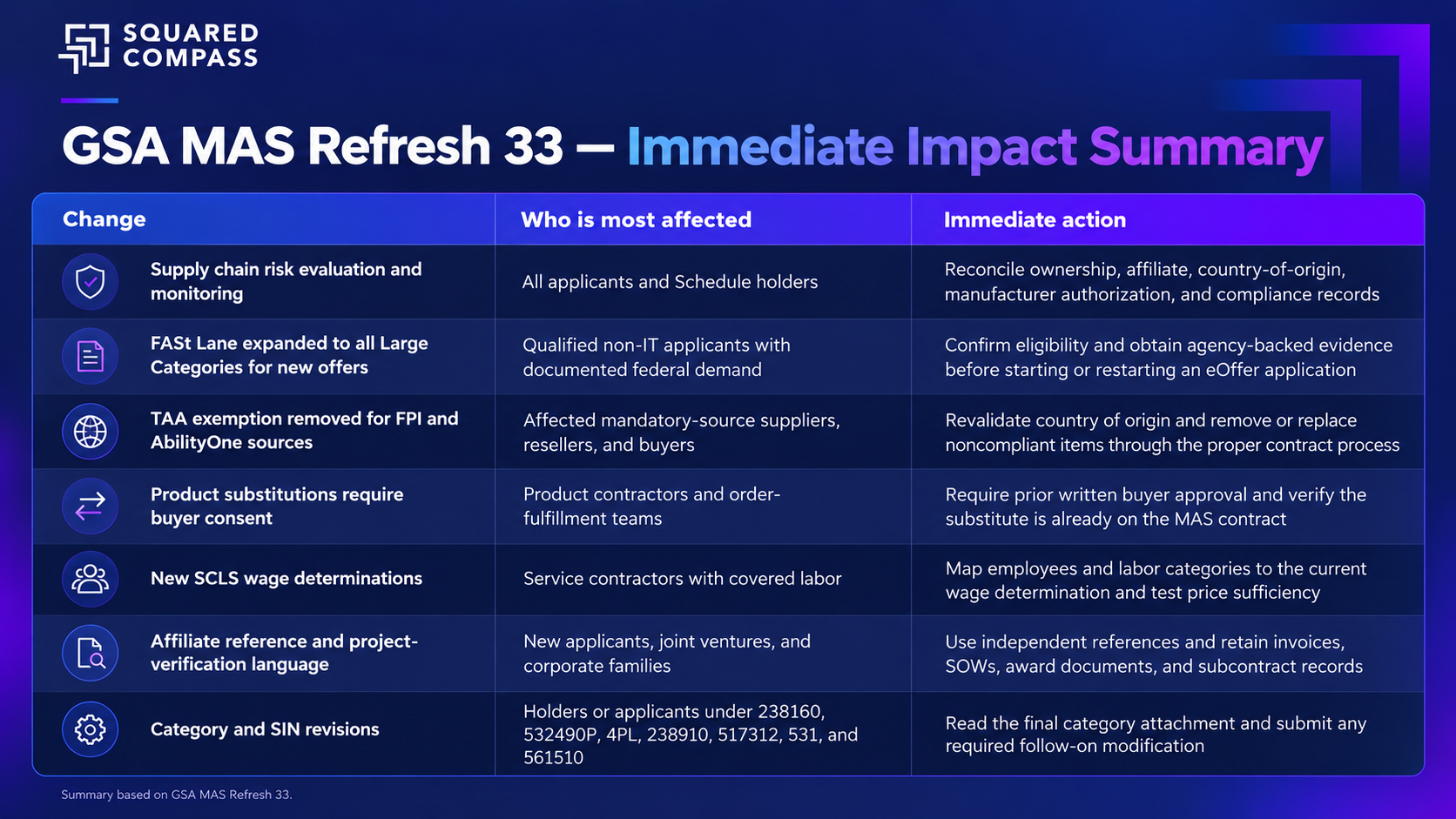
Refresh 33 at a glance
What is GSA MAS Refresh 33
Refresh 33 is the October 2, 2026 amendment to the standing GSA Multiple Award Schedule solicitation, 47QSMD20R0001. A solicitation refresh changes the terms GSA uses to evaluate new offers and administer MAS contracts. GSA also issues a contract-level mass modification so existing Schedule holders can incorporate applicable changes into their individual contracts.
The solicitation-level SF30 describes the program-wide amendment. A contractor's mass-modification SF30 is contract-specific and may include earlier unaccepted refreshes. Those two documents are related, but they are not interchangeable. GSA's Vendor Support Center refresh page explains the distinction, and the final Refresh 33 solicitation package is available through GSA's published solicitations page.
GSA's advance notice states that Refresh 33 terms apply to new task orders, delivery orders, and calls under existing Blanket Purchase Agreements issued after the modification's effective date. Orders issued before that effective date remain governed by the terms in effect when the order was awarded. That distinction matters: an older BPA does not automatically preserve the old rules for a new call.
All program wide changes in Refresh 33
Supply chain risk is now an express part of offer evaluation and contract monitoring
Refresh 33 formalizes GSA's supply chain risk management practices in three connected places:
SCP-FSS-001, the Instructions Applicable to All Offerors, now tells offerors that GSA will evaluate supply chain risk associated with the company, its proposed products and services, and related supply chains.
GSAR 552.540-70, Notice of Evaluation of Supply Chain Risk, applies during offer evaluation and allows unacceptable risk to affect whether an offer or item remains under consideration.
GSAR 552.540-71, Supply Chain Risk Monitoring, continues the review after award and throughout contract performance.
The review may cover corporate ownership, control, affiliations, subsidiaries, foreign ownership or influence, geopolitical exposure, cybersecurity, legal and regulatory compliance, upstream supplier relationships, physical and personnel risk, and the functionality or components of an offered product or service. GSA can use government information, public records, commercial screening tools, agency information sharing, Federal Acquisition Security Council information, and information supplied by the offeror.
Refresh 33 does not appear to add a universal new upload form to every MAS offer. It does, however, make accuracy and transparency more consequential. Corporate structure, ownership, country of origin, manufacturer status, Letters of Supply, and compliance representations should tell the same story across SAM.gov, eOffer, proposal narratives, catalog data, and supporting documents.
If GSA identifies risk, the contracting officer may seek mitigation. A problematic product can be removed while the rest of an offer proceeds. If risk cannot be mitigated, GSA can exclude an item or offeror during evaluation. On an active contract, the monitoring clause provides a basis for measures that can include removing an item, declining to exercise an option, canceling the contract, or terminating it, depending on the facts and governing terms. GSA describes the new provisions as a formalization of existing practices, but putting them into numbered solicitation and contract text makes the review more consistent and visible.
Impact on applications. Every applicant, including a services-only firm, should prepare a simple ownership and affiliation map and reconcile it with SAM.gov. Product applicants should also maintain item-level country-of-origin evidence and current manufacturer authorization. A clarification response should be supported by the same records used to prepare the original offer.
Impact on current Schedule holders. Supply chain diligence is no longer only an offer-stage exercise. Holders should establish a trigger-based review for acquisitions, ownership changes, new investors, manufacturer changes, sourcing changes, and discontinued items. Product data, Letters of Supply, and TAA files should remain current throughout performance.
GSA's acquisition policy library includes the agency's GSAR Part 540 supply chain resources.
FASt Lane eligibility now extends to new offers in every MAS Large Category
Before Refresh 33, FASt Lane was centered on the Information Technology Large Category. Refresh 33 opens FASt Lane consideration to new offers across the full MAS solicitation. This is a meaningful opportunity for qualified professional services, facilities, products, logistics, travel, and other non-IT applicants, but it is not automatic expedited processing.
An applicant still needs a validated federal requirement. The supporting information must allow GSA to verify that customer demand is real, specific, and compelling. In practice, the applicant will generally follow one of two paths:
The requirement is part of a GSA-designated FASt Lane eligible initiative, supported by the applicable checklist and acquisition documentation.
A federal ordering activity provides a written request explaining the requirement, the need for the company, and why expedited processing is necessary.
Important limits remain. FASt Lane treatment for modifications continues to be limited to the IT Category and designated eligible initiatives. Startup Springboard remains tied to FASt Lane participation. An expedited review also does not relax scope, financial responsibility, pricing, experience, or documentation requirements.
Applicants should verify the current GSA FASt Lane instructions before filing because the public checklist and agency-request procedures may be updated after a solicitation refresh. GSA indicated during the Refresh 33 rollout that an eligible company with an unsubmitted draft may need to initiate a new eOffer application to preserve FASt Lane treatment.
Impact on applications. Non-IT companies with a time-sensitive federal customer now have a potential expedited route. The best candidates are offer-ready before seeking priority: their SIN scope, pricing, project experience, references, financial records, and required templates should already be complete.
Impact on current Schedule holders. This expansion does not create a general fast track for non-IT contract modifications. Existing holders should avoid promising a FASt Lane modification unless the request fits the published IT rules.
The TAA exception for AbilityOne and Federal Prison Industries was removed
Refresh 33 implements GSA Class Deviation CD-2026-03. The deviation removes the prior Trade Agreements Act exception for AbilityOne Participating Nonprofit Agencies and Federal Prison Industries, Inc. Offerings from these sources must now be reviewed for TAA compliance using the same process applied to other contractors.
GSA states that the change is intended to prevent noncompliant products, including affected Chinese-origin products, from entering GSA's supply chain and to apply a consistent TAA standard. The deviation applies to GSA acquisitions, including MAS and BPAs, but not to GSA assisted acquisitions funded by other agencies. The full scope and instructions appear in GSA Class Deviation CD-2026-03.
Impact on applications. An applicant relying on an AbilityOne or FPI source cannot assume mandatory-source status resolves country-of-origin compliance. Each offered product must be supportable under the applicable TAA rules.
Impact on current Schedule holders. Affected holders and authorized distributors should identify items that depended on the former exception, document compliant origin, and coordinate deletions or replacements with the contracting officer. Contractors should not silently replace an ordered item; the new substitution rule discussed below applies.
Product substitutions now require prior written buyer consent
Refresh 33 adds product-substitution language to the General Information section of every MAS Large Category attachment. A contractor may not substitute a different product without the buyer's prior written consent. An authorized substitute must already be listed on the contractor's MAS contract and must be priced no higher than the original item, unless the customer expressly approves a higher-priced MAS-listed alternative.
This rule affects routine fulfillment events such as backorders, discontinued models, manufacturer SKU changes, bundled configurations, and distributor substitutions. Commercial equivalence is not enough. The replacement must be on the awarded contract, within scope, compliant, and documented.
Impact on applications. Product applicants should build a durable catalog, use exact manufacturer part numbers, and consider adding legitimate successor or alternate products before a customer needs them.
Impact on current Schedule holders. Sales, purchasing, warehouse, customer service, and billing teams need one control: no substitution ships until compliance confirms the item is awarded and the buyer's written approval is in the order file. If the replacement costs more, the file should include the customer's explicit approval of that higher-priced MAS item.
GSA incorporated updated Service Contract Labor Standards wage determinations
Refresh 33 incorporates the most recent Service Contract Labor Standards wage determinations. GSA has published the Refresh 33 SCLS wage determination set.
The update does not mean every employee or labor category is covered. Coverage depends on the work, place of performance, applicable exemption, contract terms, and wage determination. Contractors should map covered employees to the correct occupational classification and confirm that compensation, health and welfare, paid leave, and any applicable differentials meet the current requirement.
Impact on applications. Use the current wage determination when preparing the SCLS matrix and pricing. A labor rate that cannot absorb required wages and fringe obligations is not commercially sustainable simply because it passes an initial price review.
Impact on current Schedule holders. Recheck covered labor and order pricing before quoting work under the refreshed terms. Where an adjustment mechanism applies, follow the contract's notice and modification requirements instead of assuming the wage update automatically changes awarded ceiling rates.
Past performance references and project experience face tighter verification
The final SCP-FSS-001 contains two application changes that were not highlighted in GSA's public Significant Changes summary.
First, GSA may reject a past performance customer reference when the referencing customer is an entity the offeror partially owns, wholly owns, or is affiliated with. The addition of “affiliate” matters for parent, subsidiary, sister-company, common-control, joint-venture, and private-equity structures. The controlling definition is the applicable FAR definition, not merely whether the applicant directly owns the customer.
Second, GSA may request additional evidence to verify Relevant Project Experience, including invoices, statements of work, signed SF 1449s, and subcontract agreements. GSA may reject a project it reasonably believes was falsified.
These rules should not be confused with Startup Springboard's limited ability to substitute experience from affiliates, predecessors, or key personnel when the instructions permit it. A related entity acting as the applicant's customer reference is a different issue from using eligible affiliate experience under Springboard.
Impact on applications. Select independent customer references whenever possible. For each reference and project narrative, maintain a proof file containing the contract or subcontract, SOW or PWS, award document, invoices or payment evidence, dates, value, scope, and a reachable customer contact. Ensure the narrative matches the underlying documents.
Impact on current Schedule holders. This is primarily an offer-evaluation change, but it also matters when a holder applies for new SINs, participates in a follow-on vehicle, forms a joint venture, or prepares an option or modification package that requires experience evidence.
Category and SIN specific changes
Facilities Large Category B
SIN 238160 Roofing Products and Services Solutions
GSA revised the SIN description to clarify that an agency may buy roofing materials only, roofing services or labor only, or a combination of products and services. The earlier wording could be read as tying installation and site preparation to a product purchase for an existing roof.
Applicants should describe and price the exact portion of this expanded scope they can perform. Existing holders should check whether their awarded description and catalog clearly represent materials-only, labor-only, or combined solutions before marketing all three.
SIN 532490P Lease Rental of Pre Engineered Prefabricated Buildings and Structures
Refresh 33 broadens and clarifies the covered structures, including pre-engineered, prefabricated, portable, mobile, modular, and tension-fabric buildings and structures. Utility rooms are expressly included alongside uses such as office buildings, restrooms, and temporary living quarters. The instructions clarify general temporary-facility needs and turnkey temporary-facility solutions where the primary requirement is leasing or renting a covered structure.
GSA also:
Added the subgroup Turnkey Base Camp Facilities and Operational Support Products or Services.
Revised an existing subgroup to Lease Rental of Pre Engineered Prefabricated Restrooms Showers and Utility Rooms.
Subgroup placement is not merely a marketing label. Applicants and holders should map project evidence, technical capability, and pricing to the exact subgroup and obtain GSA approval through the applicable offer or modification process.
Miscellaneous Large Category G
Fourth Party Logistics 4PL
GSA added a note to the 4PL General Requirements explaining that bottled water may be included under the unique requirements of the 4PL SIN, even though food and beverages are generally outside MAS scope. Contractors should treat this as a narrow SIN-specific allowance, not a broad authorization to add consumable food or beverages elsewhere.
SIN 238910 Installation and Site Preparation Services
GSA added a note clarifying that ancillary services, incidental products, and equipment rentals may be ordered only in conjunction with and in direct support of products or services purchased under the Federal Supply Schedule contract. Incidental products must be separately priced and directly support the awarded installation and site preparation services.
The operational test is the relationship to the Schedule requirement. This SIN should not be used to turn unrelated construction, products, or rentals into MAS items. Applicants should show the supported product or service; holders should train capture and quoting teams to identify and separately price incidental items.
Information Technology Large Category F
SIN 517312 Wireless Mobility Solutions
Refresh 33 adds three subgroups under SIN 517312:
Managed Mobility Services, covering device-lifecycle management and related capabilities such as mobile device management, unified endpoint management, and mobile threat protection.
Managed Wireless Service, covering end-to-end management of cellular, Wi-Fi, fixed wireless, and satellite connectivity.
Enterprise Access Connectivity and Transport Services, covering WAN, MAN, and LAN connectivity delivered through technologies such as Carrier Ethernet, broadband, and fiber.
Placement is not automatic. New offerors and existing Schedule contractors may request one or more subgroups, subject to GSA technical review and approval. A company should request only the subgroup its recent projects, architecture, delivery model, and pricing can substantiate.
For existing 517312 holders, Refresh 33 creates a positioning opportunity but not an instant expansion of scope. Review the final Information Technology attachment, select the most defensible subgroup, and prepare a modification supported by project evidence that mirrors the subgroup language.
Travel Large Category L
SIN 531 Employee Relocation Solution
GSA revised the Statement of Work guidelines, including move-management requirements tied to current audit and payment standards for household-goods relocation services under Federal Management Regulation 102-118.
Applicants and current holders should compare their billing, audit, carrier-documentation, and payment workflows with the final SIN 531 SOW guidelines. Travel operations, finance, and subcontract management should agree on the evidence retained for each move.
SIN 561510 Travel Agent Services
Refresh 33 revises both the SIN 561510 Statement of Work and Price Proposal Template. The final templates control, but the operational changes include:
A new Transactional Data Reporting section and travel-specific reporting alignment.
Monthly Industrial Funding Fee reporting language.
New Department of Defense definitions, background, services, and CLINs, including IFF-related transactions.
Monthly service-level metrics plus quarterly and annual business reporting.
Aligned VIP remote or hybrid service requirements and a VIP service-level agreement.
A customer-satisfaction performance target of at least 85 percent using the GSA TMC PMO survey specified in the SOW.
Updated explanatory codes supporting GO.gov, including C6 and C7 codes for non-government funds.
A revised Price Proposal Template Read Me tab.
A new eOffer tab for Travel Management Companies, with designated ancillary CLINs required for new TMC offers.
Pricing and terminology revisions, including clarification of CLIN 317 and removal of legacy Most Favored Customer or Most Favored Agency references where shown in the revised template.
Travel Management Companies should not rely on an older workbook. Rebuild the submission or contract-impact review from the Refresh 33 SOW and PPT, then reconcile the new CLINs, reporting cadence, service levels, survey measurement, and GO.gov codes with reservation, accounting, and reporting systems.
How Refresh 33 affects new and pending GSA Schedule applications
Applications submitted on or after October 2, 2026
Build the offer against Refresh 33. Download the current base solicitation, the attachment for every proposed Large Category, the Available Offerings file, applicable templates, and any SIN-specific SOW. Do not reuse a Refresh 32 checklist without comparing it to the current package.
Offers already under review
GSA may ask an offeror to update an in-process submission to the current refresh. The assigned contracting specialist or contracting officer controls the specific correction path. Do not withdraw or recreate a submitted offer unless directed, but be ready to provide refreshed representations, templates, or clarifications.
Draft offers not yet submitted
Revalidate the entire package before submission. FASt Lane candidates should confirm whether a new eOffer application is required. Every applicant should recheck references, project documentation, ownership disclosures, Letters of Supply, country of origin, SCLS files, category attachments, and template versions.
Application checklist
Confirm the eOffer package identifies Refresh 33 and uses the October 2, 2026 documents.
Create a one-page ownership, control, affiliate, and subsidiary map.
Reconcile that map with SAM.gov, eOffer, corporate narratives, and representations.
For products, document country of origin and manufacturer authorization item by item.
Replace affiliate customer references with independent references where possible.
Build a proof file for every Relevant Project Experience narrative.
Use the current SCLS wage determination and validate price sufficiency.
Confirm each proposed SIN and subgroup against the final category attachment.
If requesting FASt Lane, obtain evidence of a validated federal requirement before submission.
Run a final version control check on every workbook, SOW, and attachment.
How Refresh 33 affects current GSA Schedule holders
Accept the contract specific mass modification on time
GSA requires acceptance no later than 90 days after the mass modification is issued to the contractor. The controlling date is the issuance date shown on the contractor's mass modification, not the date someone reads the notification. Authorized Negotiators should use GSA's Mass Mod system, review the contract-level SF30 and attachments, accept the modification, and retain the executed record.
Before acceptance, verify that the Authorized Negotiator list and email addresses are current in eOffer/eMod and that the appropriate signers can access the Mass Mod system. If an older mass modification remains outstanding, address it promptly because GSA may combine prior refresh terms into the current contract-level SF30.
GSA's mass modification guidance explains the process.
Do not rewrite previously awarded orders
Orders issued before the Refresh 33 modification's effective date remain under the terms in effect at award. New task orders, delivery orders, and BPA calls issued after the effective date use the refreshed terms. Contract administrators should record the effective date and use it when reviewing order files.
Update operating controls
Every holder should complete four reviews:
Supply chain: ownership, affiliates, restricted-source screening, country of origin, manufacturer authorization, and supplier changes.
Fulfillment: prior written approval for substitutions, awarded-item verification, price comparison, and order-file retention.
Labor: SCLS coverage, occupational mapping, wage and fringe compliance, and rate sufficiency.
Contract scope: affected SINs, new subgroups, SOWs, PPTs, and any follow-on modification required to market or sell the revised scope.
Holder checklist for the first 30 days
Download and route the contract-level SF30 to contracts, legal, compliance, operations, and finance.
Calendar an internal acceptance deadline well before day 90.
Confirm at least two current Authorized Negotiators can access the Mass Mod system.
Compare the contract-level SF30 with the solicitation-level changes relevant to the awarded SINs.
Issue a written no-substitution-without-approval procedure to sales and fulfillment teams.
Audit ownership, affiliate, TAA, Letter of Supply, and supplier records.
Update SCLS mappings and test labor-rate sufficiency.
Review every affected SIN attachment and decide whether a separate modification is needed.
Train capture teams on the effective-date rule for new orders and BPA calls.
Retain the accepted SF30 and implementation evidence in the contract file.
The larger meaning of Refresh 33
Refresh 33 is not a wholesale redesign of MAS. Its importance comes from connecting offer evaluation, ongoing contract monitoring, and daily order execution.
The supply chain provisions make corporate and product transparency a life-cycle obligation. The affiliate-reference change makes independence and documentary proof more important in applications. The substitution rule reaches the warehouse and customer-service desk. FASt Lane creates a broader route to expedited award, but only when a federal customer requirement is documented. The category changes then create targeted opportunities in roofing, temporary facilities, managed mobility, wireless services, network transport, relocation, and travel management.
The strongest response is therefore cross-functional. Contracts teams cannot implement Refresh 33 alone. Business development, operations, purchasing, HR, finance, information security, and executive leadership each own part of the evidence GSA may review.
Frequently asked questions about MAS Refresh 33
When was GSA MAS Refresh 33 released
GSA issued MAS Solicitation 47QSMD20R0001 Refresh 33 on October 2, 2026.
How long do Schedule holders have to accept the Refresh 33 mass modification
The mass modification must be accepted no later than 90 days after GSA issues it to the contractor. Check the date on the contract-specific SF30 because that document controls the deadline.
Do Refresh 33 terms change existing task orders
Orders issued before the modification's effective date remain governed by the terms in effect at award. New task orders, delivery orders, and calls under existing BPAs issued after the effective date use the refreshed terms.
Is FASt Lane now available for every GSA MAS category
New offers in every MAS Large Category may be considered for FASt Lane when the offeror demonstrates a validated federal requirement. FASt Lane modifications remain limited to the IT Category and designated eligible initiatives.
Can a contractor substitute an equivalent product when the ordered item is unavailable
Not without the buyer's prior written consent. The substitute must already be on the contractor's MAS contract and generally cannot cost more than the original item unless the customer expressly approves a higher-priced MAS-listed alternative.
What are GSAR 552.540-70 and 552.540-71
GSAR 552.540-70 addresses evaluation of supply chain risk during the offer process. GSAR 552.540-71 addresses supply chain risk monitoring after award and during contract performance.
Can an affiliate serve as a past performance customer reference
GSA may reject a reference from an entity the offeror partially owns, wholly owns, or is affiliated with. Applicants should use independent customer references when possible and distinguish this rule from the separate Startup Springboard provisions for eligible substituted experience.
Were any SINs added or removed in Refresh 33
The material structural change highlighted by GSA is the addition of three subgroups under SIN 517312 Wireless Mobility Solutions, not the creation of three new SIN numbers. Refresh 33 also revises the scope or instructions for SINs 238160, 532490P, 4PL, 238910, 531, and 561510.
What should a Schedule holder do first
Confirm the mass modification issuance date and Authorized Negotiators, review the contract-specific SF30, identify affected SINs, and implement supply chain and product-substitution controls before accepting within the 90-day window.
How Squared Compass can help
Refresh 33 rewards companies that connect compliance to capture and execution. Squared Compass helps government contractors evaluate contract-vehicle fit, prepare and maintain GSA MAS strategies, identify relevant opportunities, and build operating plans that support sustainable federal growth. Learn more about our Best in Class contract vehicle services and Government Contracting Playbook.
This article provides general educational information and is not legal advice. The final solicitation, the contractor's SF30, and direction from the assigned GSA contracting officer control.
Primary sources
Final Refresh 33 solicitation package on GSA eOffer
Official SAM.gov notice for Solicitation 47QSMD20R0001
GSA Interact advance notice for Refresh 33
GSA Vendor Support Center solicitation refresh archive
GSA Class Deviation CD-2026-03
GSA modification and mass modification guidance
GSA Refresh 33 SCLS wage determinations
GSA acquisition policy library and supply chain security resources