For decades, one of the defining characteristics of a General Services Administration (GSA) Schedule contract was its 20-year expiration date. Even the most successful federal contractors eventually had to prepare and submit a replacement contract offer.
That is changing.
On November 12, 2026, GSA released Multiple Award Schedule (MAS) Solicitation Refresh 34, introducing potentially indefinite Schedule contracts, new artificial intelligence safeguards, revised pricing requirements, and additional measures to promote American manufacturing.
These changes are part of the Revolutionary GSAR Overhaul (RGO), a broader effort to modernize federal acquisition, reduce administrative burdens, and improve how the government purchases commercial products and services.
For existing GSA Schedule holders, Refresh 34 introduces new compliance considerations. For companies considering entering the federal marketplace, it potentially makes obtaining a GSA Schedule an even more valuable long-term investment.
What is GSA MAS Refresh 34?
GSA MAS Refresh 34 is the November 2026 update to the General Services Administration's Multiple Award Schedule solicitation, 47QSMD20R0001.
The refresh incorporates Wave 4 of the Revolutionary GSAR Overhaul and introduces changes affecting contract duration, artificial intelligence, economic price adjustments, domestic manufacturing certifications, catalog management, and selected Special Item Numbers (SINs).
Existing GSA Schedule contractors generally have 90 days from issuance of the associated mass modification to accept the updated contract terms.
GSA MAS Refresh 34: Key changes at a glance
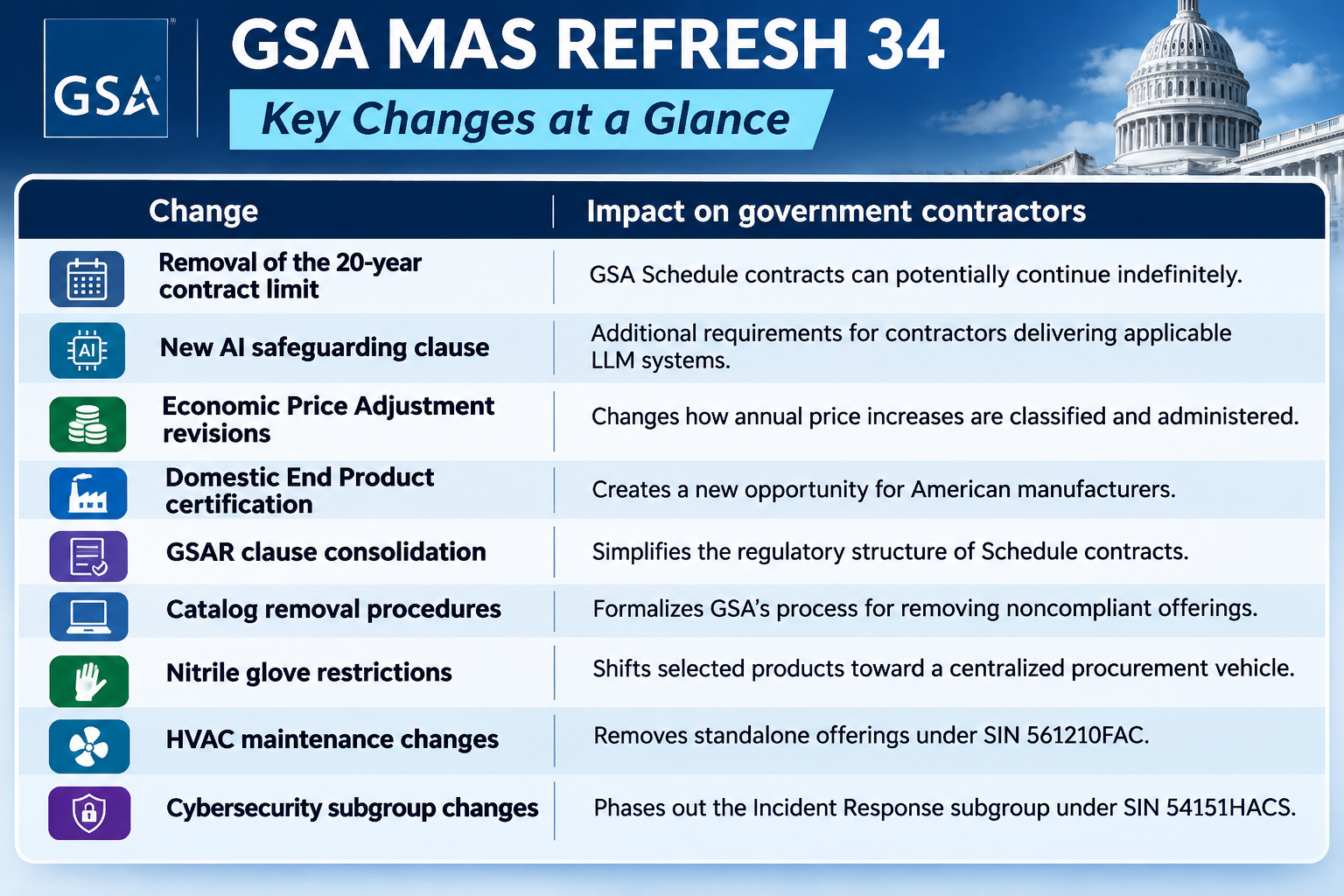
1. GSA eliminates the 20-year Schedule contract limit
Perhaps the most consequential development in Refresh 34 is the introduction of what GSA calls evergreen contracting.
Historically, GSA Schedule contracts consisted of a five-year base period followed by three potential five-year option periods, resulting in a maximum contract duration of 20 years.
Under the revised GSAR 552.238-116, Option to Extend the Term of the FSS Contract, GSA can continue exercising additional option periods without a predefined maximum contract duration.
How long can a GSA Schedule contract last after Refresh 34?
Potentially indefinitely, provided GSA continues exercising its contractual options and the contractor satisfies applicable requirements.
This could provide several benefits:
Reduced administrative costs associated with replacement offers.
Greater continuity for established government contractors.
Improved long-term federal market planning.
Reduced potential disruption to established contracting relationships.
Greater long-term strategic value for businesses investing in Schedule acquisition.
However, evergreen does not mean permanent.
GSA retains discretion over whether to exercise contract options. Contractors must continue meeting sales, reporting, pricing, and other contractual requirements.
Additionally, this change applies to the underlying GSA Schedule contract, not automatically to individual task orders, delivery orders, or Blanket Purchase Agreements (BPAs).
Until GSA completes its implementation of evergreen contracting, contractors approaching their existing expiration dates should continue following established streamlined replacement offer procedures.
Does Refresh 34 eliminate GSA minimum sales requirements?
No.
Contractors remain subject to applicable minimum sales criteria, including the existing $100,000 threshold during the first five-year period and $125,000 during subsequent five-year periods.
Evergreen contracting reduces the administrative burden of maintaining a successful Schedule contract. It does not eliminate the requirement to generate government sales.
2. GSA introduces new artificial intelligence contract requirements
Artificial intelligence is rapidly becoming part of the federal government's technology infrastructure. With that adoption comes increased scrutiny of government data protection, intellectual property, cybersecurity, and commercial AI providers.
Refresh 34 introduces GSAR 552.239-7001, Basic Safeguarding of Data within Large Language Model Artificial Intelligence Systems.
The clause establishes contractual safeguards for applicable large language model (LLM) systems purchased through GSA contracts.
It is particularly relevant to companies providing:
Generative AI platforms and applications.
AI agents and agentic systems.
Government-facing chatbots.
LLM-enabled productivity software.
AI-powered knowledge management platforms.
Commercial software with material embedded LLM capabilities.
One of the most important requirements concerns government data. Applicable commercial AI providers face restrictions on using government inputs, prompts, outputs, and related information to train or improve models and services for other customers.
For AI technology companies, compliance may extend beyond the application itself. Businesses should evaluate their underlying model providers, commercial licensing agreements, data retention policies, hosting environments, and subcontractor arrangements.
Does the new GSA AI clause apply to contractors using ChatGPT internally?
Generally, internal use of artificial intelligence does not, by itself, trigger the new clause.
A consulting firm using an AI tool to support internal research or proposal development is materially different from a technology company delivering an AI system that processes government data.
The distinction is particularly important for professional services contractors, software developers, and federal technology consultants.
Existing cybersecurity, confidentiality, intellectual property, and government data protection obligations still apply, regardless of whether the new clause is triggered.
What should AI companies do before pursuing a GSA Schedule?
Companies selling artificial intelligence products and services to the federal government should evaluate their technical and contractual readiness before submitting a Schedule offer or pursuing government orders.
At a minimum, they should understand where government data is stored, which third parties process it, whether that data is retained, and whether their commercial AI architecture can satisfy government contractual requirements.
As AI becomes more integrated into federal acquisition, contractual readiness could become as important as the technology itself.
3. GSA restructures Economic Price Adjustments
Refresh 34 also changes how contractors manage price increases under their GSA Schedule contracts.
GSAR 552.216-90, Alternate I, replaces the previous Economic Price Adjustment (EPA) clause, GSAR 552.238-120.
The most significant distinction is that predetermined annual price escalation will no longer be classified as an Economic Price Adjustment mechanism, effective November 30, 2026.
Instead, fixed annual escalation will be treated as an established contractual pricing arrangement.
What happens to existing GSA annual price increases?
Contractors with previously negotiated annual price escalation arrangements can retain those arrangements under their established contract terms.
Other mechanisms, including eligible market index adjustments and price changes resulting from significant unforeseen market conditions, remain available.
New GSA Schedule offerors can also propose fixed annual price escalation, subject to solicitation requirements and contracting officer approval.
For professional services, staffing, engineering, and information technology companies, this distinction matters because labor costs frequently increase over the life of a government contract.
Companies submitting new Schedule offers should ensure their pricing strategies account for long-term wage growth, inflation, and changes in operating expenses.
Winning a government contract is important. Winning one that remains profitable throughout its performance period is equally important.
4. GSA creates new opportunities for American manufacturers
Refresh 34 introduces a voluntary Federal Supply Schedule Domestic End Product certification under GSAR 552.238-130.
The objective is to help federal buyers more easily identify qualifying American-made products.
To qualify, products must be manufactured in the United States and satisfy applicable domestic component cost requirements.
Product categoryDomestic manufacturing requirementMost manufactured productsU.S. component costs must exceed 75% of total component costsProducts consisting predominantly of iron or steelForeign iron or steel costs must represent less than 5% of total component costs
GSA intends to identify qualifying products through GSA Advantage once the associated information collection and implementation requirements are satisfied.
This could create an additional competitive differentiator for American manufacturers operating in industries such as furniture, industrial equipment, machinery, facilities products, and office supplies.
Is the new domestic product certification mandatory?
No. The certification is voluntary.
It is also distinct from existing Trade Agreements Act (TAA) requirements. Contractors should not assume that a product qualifying under one standard automatically qualifies under another.
Manufacturers and resellers should maintain appropriate documentation supporting their certifications. Knowingly inaccurate representations could expose businesses to government enforcement actions, including potential liability under the False Claims Act.
For American manufacturers evaluating federal market entry, this development provides another reason to assess whether the GSA Schedule program aligns with their growth strategy.
5. GSA simplifies its regulatory framework
The GSA Acquisition Regulation overhaul is intended to reduce duplicative requirements and simplify contract administration.
Refresh 34 consolidates numerous existing requirements into five principal GSAR clauses.
GSAR clauseSubject552.238-190Federal Supply Schedule Contractor Team Arrangements552.238-191Federal Supply Schedule contract requirements552.238-192Federal Supply Schedule order requirements552.238-193Product offering and sales requirements552.238-194Sales criteria
The restructuring removes dozens of legacy provisions and consolidates requirements previously distributed throughout the Schedule solicitation.
While many underlying obligations remain, contractors should update their internal compliance procedures, contract administration documentation, and references to applicable clauses.
Businesses preparing new GSA Schedule offers should also ensure they are using the current version of SCP-FSS-001, Instructions Applicable to All Offerors.
Using an outdated GSA proposal template can create unnecessary administrative delays and potentially result in a deficient submission.
6. GSA formalizes catalog removal procedures
Under revised GSAR 552.238-77, GSA establishes clearer procedures for removing noncompliant catalog information.
The updated framework addresses contractor notification, removal periods, potential extensions, and restrictions on new orders for affected items.
For contractors selling through GSA Advantage, maintaining accurate catalog information is not merely an administrative exercise. It directly affects product visibility and the ability of government customers to place orders.
Contractors should regularly verify their awarded pricing, product descriptions, manufacturer information, country of origin, and catalog availability.
A GSA Schedule contract that remains technically active but contains unavailable or noncompliant products is not an effective government sales vehicle.
7. Refresh 34 changes selected GSA Special Item Numbers
Although several Refresh 34 changes apply across the Schedule program, others affect specific industries and Special Item Numbers.
Nitrile gloves and personal protective equipment
GSA is moving toward consolidating selected domestically manufactured nitrile glove purchases under the Department of Homeland Security's Best-in-Class PPE Safety Stock contract.
Affected products include certain blue and black medical-grade nitrile gloves.
Existing suppliers should monitor communications from their contracting officers regarding affected products and potential catalog removals.
SIN 561210FAC: Facilities Support Services
Refresh 34 removes the HVAC maintenance subgroup and eliminates HVAC maintenance as a standalone offering under SIN 561210FAC.
Facilities contractors should evaluate whether their HVAC services remain appropriately categorized within their broader awarded facilities maintenance offerings.
SIN 54151HACS: Highly Adaptive Cybersecurity Services
GSA is phasing out the voluntary Incident Response subgroup under SIN 54151HACS at the end of fiscal year 2027.
Contractors currently operating under this subgroup should evaluate eligibility for the Incident Handling and Event Management (IHEM) subgroup, which incorporates incident response capabilities.
For cybersecurity providers, the change is an opportunity to evaluate how their existing Schedule offerings align with broader federal cybersecurity requirements.
8. What should GSA Schedule contractors do now?
Existing Schedule holders should treat Refresh 34 as an opportunity to conduct a broader contract health assessment rather than simply accept another mass modification.
Squared Compass recommends the following actions:
Review and accept the applicable mass modification within the required acceptance period.
Retain the executed Standard Form 30 (SF30).
Identify regulatory changes applicable to your specific contract.
Review Economic Price Adjustment and fixed annual escalation arrangements.
Determine whether your AI products or services trigger GSAR 552.239-7001.
Evaluate opportunities for voluntary Domestic End Product certification.
Review affected SINs, awarded offerings, and GSA Advantage catalogs.
Update internal compliance documentation.
Assess minimum sales performance and upcoming contract option periods.
Reevaluate your federal capture and business development strategy.
Contractors should use their individual contract-level SF30 as the authoritative record of the modifications applicable to their contracts.
The solicitation-level changes published by GSA may differ from the modifications issued to individual Schedule holders.
9. Is getting a GSA Schedule worth it in 2027?
Refresh 34 strengthens the long-term business case for obtaining a GSA Schedule, particularly for companies planning to establish a sustained presence in the federal marketplace.
The removal of the 20-year limitation potentially reduces future administrative costs. Regulatory consolidation could simplify contract management, while new domestic product identification could improve visibility for American manufacturers.
However, companies should not confuse obtaining a GSA Schedule with winning government contracts.
A GSA Schedule is a contracting vehicle. It provides eligible government buyers with a mechanism to purchase your products and services, but it does not guarantee revenue.
Businesses considering obtaining a GSA Schedule should first evaluate:
Historical federal spending within their target market.
Relevant Special Item Numbers.
Existing competitors and market concentration.
Target government agencies.
Pricing competitiveness.
Contract administration requirements.
Their ability to develop and maintain a federal sales pipeline.
The value of a Schedule contract ultimately depends on how effectively a company uses it.
The Squared Compass perspective: A more valuable contracting vehicle, not a guaranteed sales pipeline
Refresh 34 reflects a broader evolution in federal government contracting.
GSA is moving toward a contracting environment characterized by reduced administrative duplication, stronger data safeguards, more flexible contract lifecycles, and increased attention to domestic manufacturing.
For businesses, this creates both opportunities and responsibilities.
The introduction of evergreen contracting could make a GSA Schedule one of the most enduring assets in a company's federal market strategy. At the same time, contractors must continue investing in compliance, capture management, competitive positioning, and government customer relationships.
At Squared Compass, we believe government contracting should be approached as a business growth strategy, not simply a registration or certification exercise.
Through GovCon Sherpa, we help companies evaluate federal market opportunities, obtain GSA Schedule contracts, maintain contract compliance, and build the capture capabilities necessary to compete for government business.
Since 2019, organizations we have supported have been awarded approximately $732 million in total contract value.
Whether your company is preparing its first GSA Schedule offer, reviewing the implications of Refresh 34, or attempting to generate more revenue from an existing Schedule contract, the objective should remain the same: build a sustainable and profitable government business.
We guide the climb. You own the summit.
Frequently asked questions about GSA MAS Refresh 34
When was GSA MAS Refresh 34 released?
GSA released MAS Solicitation Refresh 34 on November 12, 2026.
How long do contractors have to accept Refresh 34?
Existing GSA Schedule holders generally have 90 days from issuance of the associated mass modification to accept it. Contractors should verify their specific deadline in the GSA Mass Modification system.
Did GSA eliminate the 20-year Schedule contract limit?
Yes. Refresh 34 removes the predefined maximum contract duration. GSA may continue exercising additional option periods, subject to contractor eligibility and government discretion.
Are GSA Schedule contracts now permanent?
No. Although contracts can potentially continue indefinitely, extensions are not guaranteed. Contractors must continue satisfying applicable contractual requirements.
What is the new GSA artificial intelligence clause?
GSAR 552.239-7001 establishes safeguards for government data processed within applicable large language model artificial intelligence systems.
Can GSA contractors still increase their prices annually?
Yes. Previously negotiated fixed annual escalation arrangements remain in place, and new offerors may propose annual escalation arrangements. Fixed annual escalation is no longer classified as an EPA mechanism under the revised framework.
Does Refresh 34 change Trade Agreements Act compliance?
The new voluntary Domestic End Product certification is separate from existing Trade Agreements Act requirements. Contractors should evaluate compliance with each applicable standard independently.
Does obtaining a GSA Schedule guarantee government sales?
No. A GSA Schedule provides access to a government purchasing vehicle. Contractors still need an effective capture, marketing, and business development strategy.
Official GSA resources
GSA Vendor Support Center: MAS Solicitation Refreshes — https://vsc.gsa.gov/drupal/node/175
GSA Economic Price Adjustment Guidance — https://www.gsa.gov/sell-to-government/step-1-learn-about-government-contracting/how-to-access-contract-opportunities/help-with-mas-contracts-to-sell-to-government/requirements-after-getting-a-mas-contract/modification-and-mass-modification-guidance/implement-epa-clause
GSA Mass Modification Portal — https://mcm.fas.gsa.gov/
GSA eLibrary — https://www.gsaelibrary.gsa.gov/
GSA Advantage — https://www.gsaadvantage.gov/
Federal Acquisition Regulations — https://www.acquisition.gov/
Information current as of November 25, 2026. Contractors should consult their executed contract modifications and current GSA guidance for contract specific requirements.
Want to get on a GSA schedule or need help administrating and selling on your current GSA contract? Let’s chat.