White House Proposes $810 Million Federal Funding Cut: What Businesses Need to Know
The short answer: On September 25, the White House proposed canceling approximately $810 million in unspent federal funding across 11 budget accounts. The proposal names programs in refugee assistance, education, housing counseling, health research, and other areas. It does not identify specific existing grants or contracts that will be terminated. Businesses should check the funding source and status of their own awards before changing work or revenue forecasts.
The timing makes this more than a routine budget proposal. The White House sent its request to Congress five days before the September 30 end of the federal fiscal year. It intends to use a process known as a pocket rescission, which could allow the targeted funding to expire while Congress is still considering the request. The legality of that approach is disputed.
For public sector businesses, the distinction is critical: a cut to unspent money in an agency account is not the same as cancellation of every award previously funded through that account.
Which federal programs are targeted?
The White House’s September 25 notice to Congress proposes 11 reductions totaling $809.5 million, rounded to $810 million.
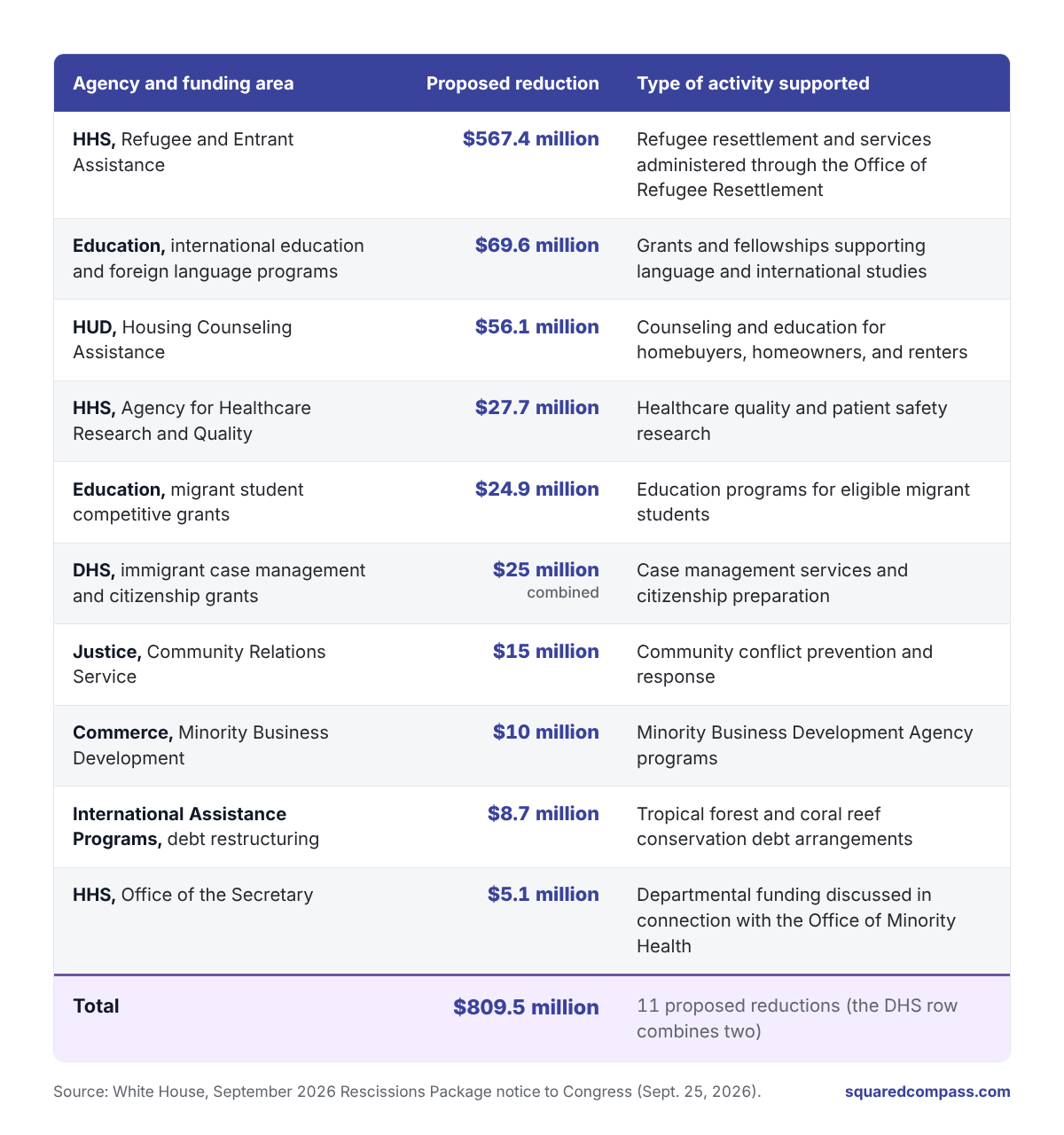
The administration says the proposed cuts would eliminate spending it considers unnecessary or inconsistent with its priorities. Those are the administration’s stated reasons. The notice provides account level amounts, not a complete list of individual recipients or award numbers affected.
What is a pocket rescission?
A rescission is a request to cancel funding Congress has already appropriated. Under the normal process, Congress has a 45 day period to act on the president’s request. In a pocket rescission, the request arrives so close to a funding deadline that the money may expire while it is being withheld, before Congress votes on whether to cancel it.
The Government Accountability Office says pocket rescissions are unlawful because they can bypass Congress’s spending authority. The administration takes the opposite view. Republican Sen. Susan Collins, who chairs the Senate Appropriations Committee, called this $810 million package unlawful. The legal dispute remains relevant to what happens next; it does not tell an individual organization whether its award has changed today.
Are the recipients named by the White House losing these funds?
The public notice does not establish that. In a separate statement, the White House identified organizations and projects that received funding in the past. Those examples illustrate its case for reducing the accounts. They should not be read as a list of recipients losing the newly targeted $810 million.
Consider housing counseling. The White House named UnidosUS, National Urban League, and Housing Action Illinois. HUD’s award announcement confirms that they received Homeownership Initiative grants in 2024 to counsel prospective buyers. The new proposal, however, targets $56.1 million in unspent FY2025 housing counseling funding. A prior award and an unspent balance are different records.
The same issue appears in health research. The White House cited a telehealth study at Seattle Children’s Hospital. HHS’s grant record shows $428,296 in award actions from 2023 through 2025 and a listed performance period ending March 31, 2026. That verifies the historical project; it does not identify the project as part of the proposed $27.7 million reduction to the Agency for Healthcare Research and Quality.
For organizations evaluating exposure, four terms matter:
Appropriated funding is money Congress has made available to an agency.
Unobligated funding has not yet been committed through an award or other legal obligation.
Obligated funding has been committed by the government, subject to the terms of that obligation.
Payments are amounts disbursed against eligible work or expenses.
The proposal concerns identified budget authority. Its announcement alone does not answer what will happen to a particular organization’s award, pending application, reimbursement, or subcontract.
What should grant recipients and government contractors do?
If you hold a federal grant: Locate the award number, assistance listing, awarding agency, funding fiscal year, and latest award amendment. Ask your grants officer whether the proposal affects an existing obligation, a future budget period, a pending continuation, or an expected reimbursement. Request the answer in writing.
If you are a subrecipient or vendor: Ask the prime recipient which award funds your work and whether it has received an agency notice. Continue to follow the terms of your agreement and any authorized written direction.
If you hold a federal contract: Check whether your contract or a pursuit depends on one of the named programs. This package largely concerns assistance and grant accounts; it is not a cancellation of contracts. For an active contract, rely on its terms and direction from the authorized contracting officer.
If you are pursuing new work: Mark opportunities that depend on a future grant award, continuation, or agency obligation before September 30. Distinguish those from opportunities already supported by obligated funds. Update the funding assumption in your pipeline instead of treating every opportunity in a named program as canceled.
What happens next?
Watch for agency notices that identify specific awards, competitions, or planned obligations, congressional action, and any court ruling that changes the administration’s ability to withhold these funds. The White House’s account level proposal is the starting point for that analysis. It is not a substitute for an award level determination.
For public sector businesses, the sound response is to verify funding at the award level, document agency guidance, and adjust forecasts where future obligations are genuinely uncertain.
Squared Compass helps organizations assess federal funding changes, manage active government work, and make informed capture decisions. To win more, set up a time to chat with our team.
Frequently asked questions
Did the White House cancel $810 million in federal contracts?
No contract level cancellation list appears in the September 25 notice. It proposes reductions across 11 federal budget accounts, many of which support grants and assistance programs. A contractor must check its specific contract and agency direction.
Does a past grant from one of these programs mean my current award is affected?
No. The White House names some historical recipients, but the notice does not connect those examples to each dollar it proposes to cancel. Check your award number, funding fiscal year, and agency correspondence.
Which program accounts face the largest proposed cuts?
HHS Refugee and Entrant Assistance accounts for $567.4 million of the approximately $810 million package. The next largest reductions are $69.6 million for international education and foreign language programs and $56.1 million for HUD housing counseling.