SBA 8(a) and EDWOSB Eligibility Scrutiny: The New Compliance Reality for Small Business Contractors?
For years, many federal contractors treated socioeconomic certifications like a badge on a capability statement: useful, valuable, and mostly static once awarded. That era is fading fast.
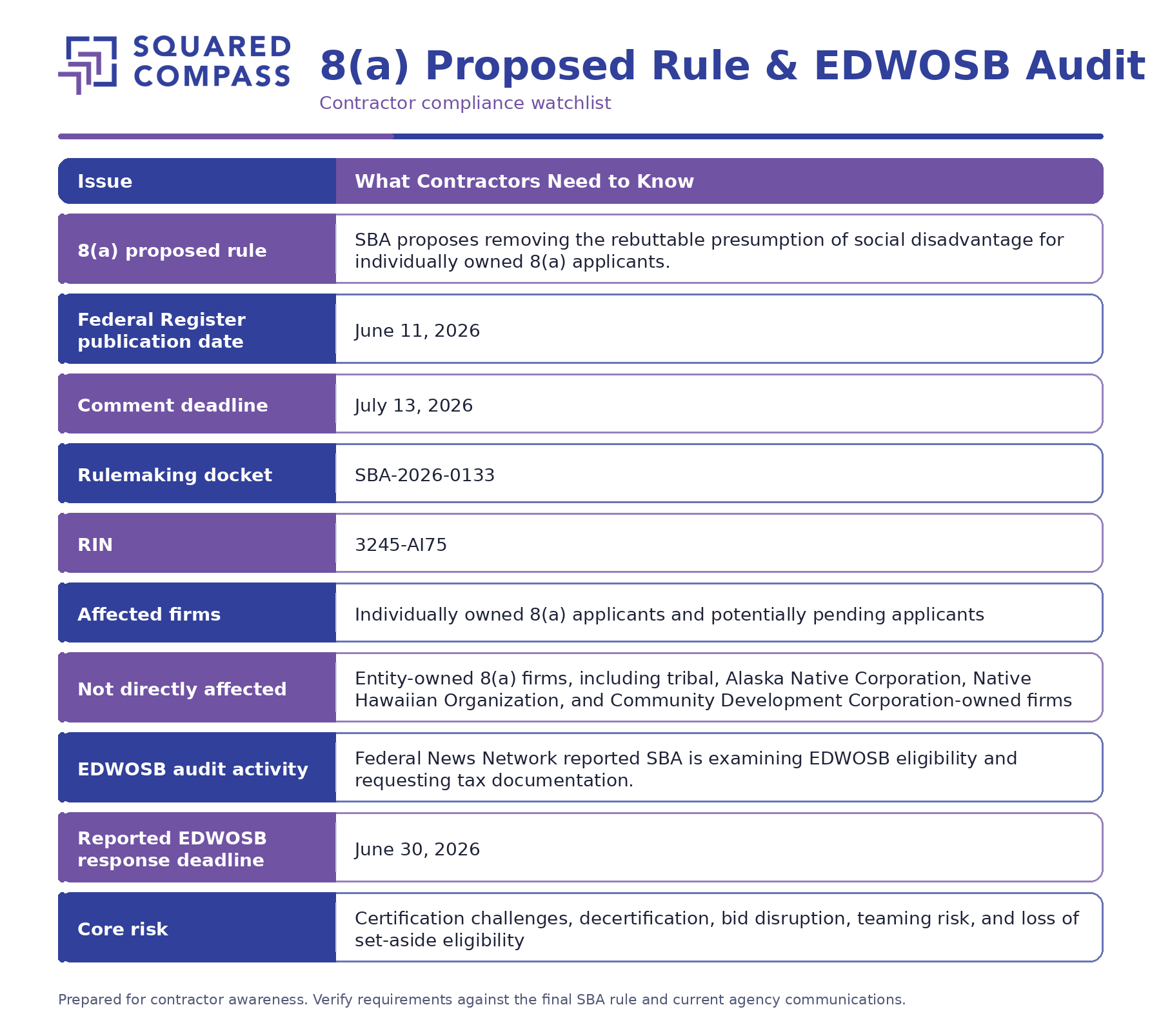
The Small Business Administration is sharpening its scrutiny of small-business contracting eligibility, especially for the 8(a) Business Development Program and Economically Disadvantaged Women-Owned Small Businesses, better known as EDWOSBs. On June 11, 2026, SBA published a proposed rule that would remove the rebuttable presumption of social disadvantage for individually owned 8(a) firms and require applicants to provide verifiable, fact based evidence of social disadvantage. Separately, Federal News Network reported on June 12, 2026, at 6:01 p.m. that SBA is examining EDWOSB firms and requesting survey responses plus three years of personal and business tax returns by June 30, 2026.
The message for contractors is simple: 8(a), WOSB, and EDWOSB status is no longer just a market differentiator. It is a live compliance obligation.
Key Facts at a Glance
Why This Matters Now
Small business certifications sit at the center of billions of dollars in federal procurement strategy. Agencies use them to meet statutory goals. Primes rely on them for teaming and subcontracting plans. Small firms use them to access set-aside and sole source opportunities.
That makes certification status powerful. It also makes it risky.
The 8(a) program is designed to help socially and economically disadvantaged small-business owners compete in the federal marketplace. SBA describes the program as a federal contracting and training program for experienced small-business owners who are socially and economically disadvantaged, with participation also available to eligible entity owned firms such as those owned by Alaska Native Corporations, Community Development Corporations, Indian tribes, and Native Hawaiian organizations.
When eligibility standards change, the impact ripples through capture strategy, proposal calendars, teaming agreements, agency acquisition planning, and bid protest risk. In other words, this is not just an SBA paperwork story. It is a pipeline story.
What Is Changing in the 8(a) Program?
SBA’s June 11, 2026 proposed rule would amend 13 CFR Part 124 to remove the rebuttable presumption that individuals belonging to certain designated groups are socially disadvantaged. The rule would instead establish revised standards for individuals to prove social disadvantage through evidence.
Under the previous framework, members of certain listed racial or ethnic groups could receive a rebuttable presumption of social disadvantage. SBA’s proposed rule would eliminate that presumption for individually owned 8(a) firms. Going forward, individual applicants would need to provide evidence that they experienced social disadvantage in a way that caused material economic harm.
Think of it as the difference between showing a boarding pass and proving how you earned the seat. The destination may still be the 8(a) program, but SBA wants a much more detailed record before letting applicants on the plane.
What Is the Rebuttable Presumption of Social Disadvantage?
The rebuttable presumption allowed certain applicants to establish social disadvantage based on membership in designated racial or ethnic groups, unless SBA had evidence to rebut that presumption.
SBA’s proposed rule would remove that presumption for individually owned firms. The Federal Register notice states that applicants would need to submit verifiable, fact based evidence instead of qualifying based on membership in a racial minority group.
In practical terms, SBA is moving from a category-based presumption to an evidence-based eligibility standard.
That shift matters because it changes the nature of the application file. A strong 8(a) application may need to look less like a personal narrative and more like a litigation ready record: facts, documents, dates, policies, decisions, economic consequences, and a clear connection between the alleged disadvantage and the applicant’s business or professional trajectory.
Why Is SBA Making This Change?
SBA cites the 2023 Ultima Services Corp. v. USDA decision as a key legal driver. In that case, a federal district court held that SBA’s rebuttable presumption violated equal protection principles and enjoined SBA from continuing to use the presumption in the 8(a) program.
SBA’s Federal Register notice states that, since Ultima, the agency has been making social-disadvantage determinations under the non-presumptive standard in 13 CFR 124.103(c). The proposed rule would codify that post-Ultima approach and remove the older presumption from SBA regulations.
SBA’s own June 11 press release framed the rule as an effort to end race-based admissions in the 8(a) program and require applicants to prove social disadvantage through verifiable, fact based evidence. Because this is an agency press release, it is useful for understanding SBA’s position, but it should be read as the agency’s policy framing rather than neutral analysis.
Which 8(a) Firms Are Affected?
The proposed rule applies to individually owned 8(a) applicants.
SBA states that the proposal does not amend or affect the eligibility of entity-owned 8(a) businesses, including firms owned by tribes, Alaska Native Corporations, Native Hawaiian Organizations, or Community Development Corporations.
That distinction is important. The rule is not a blanket rewrite of every pathway into the 8(a) program. It is focused on how individuals, not eligible entities, establish social disadvantage.
Current 8(a) participants are in a more nuanced position. SBA says it does not currently intend to apply the new test to current participants at their next annual review, but the Federal Register notice asks for comments on implementation and reliance issues.
Translation: current 8(a) firms should not panic, but they should not nap either.
What Evidence Will 8(a) Applicants Need?
The proposed rule is built around a more document-driven showing of social disadvantage. SBA says individuals would need to establish social disadvantage with verifiable, fact based evidence rather than relying on presumed group membership.
A strong evidence file may include:
Examples of 8(a) Supporting Evidence
Government policies, rules, or official statements
Corporate, institutional, or university policies
Court decisions or administrative rulings
Agency findings, audits, or reports
Records showing exclusion from business, contracting, capital, or professional opportunities
Documentation showing diminished access to credit, financing, education, employment, or advancement
Evidence that a policy or practice favored another group in a way that caused material harm
The key phrase is material economic harm. SBA is not merely asking whether unfairness existed in the abstract. It is asking whether the applicant can connect disadvantage to a real economic consequence.
What Does “Material Economic Harm” Mean?
For contractors, “material economic harm” should be understood as meaningful harm to economic opportunity. That could involve diminished access to capital, contracts, credit, education, business ownership, professional advancement, or comparable opportunities.
A useful way to organize an 8(a) evidence file is to build a four link chain:
The Four-Link Evidence Chain
First, identify the group.
The applicant should clearly identify the racial, ethnic, or cultural group at issue.
Second, document the conduct.
The applicant should show that a government or private entity discriminated against that group, was biased against that group, or favored another group.
Third, connect the applicant personally.
The applicant should show how the conduct affected them, not merely how it affected others generally.
Fourth, prove economic harm.
The applicant should explain how the experience reduced economic opportunity in a concrete way.
If one link is weak, the file may wobble. If all four are strong, the application becomes much harder to dismiss.
What Is Happening with EDWOSB Eligibility?
The EDWOSB development is separate from the 8(a) proposed rule, but it points in the same direction: more verification, more documentation, and less tolerance for stale certification files.
Federal News Network reported on June 12, 2026, that SBA sent emails to economically disadvantaged women-owned small businesses giving them until June 30, 2026 to respond to a survey and provide personal and business tax returns for the last three years. The report said SBA cited program examination authority under 13 CFR 127.400 and eligibility standards under 13 CFR 127.203.
This deserves careful wording. The 8(a) proposed rule is confirmed in the Federal Register. The EDWOSB examination details come from Federal News Network’s reporting on an SBA email, and the article says SBA did not return a request for comment.
Still, the underlying regulatory framework is real. SBA’s EDWOSB rules define economic disadvantage and provide procedures for eligibility examinations and decertification.
What Are the EDWOSB Financial Eligibility Requirements?
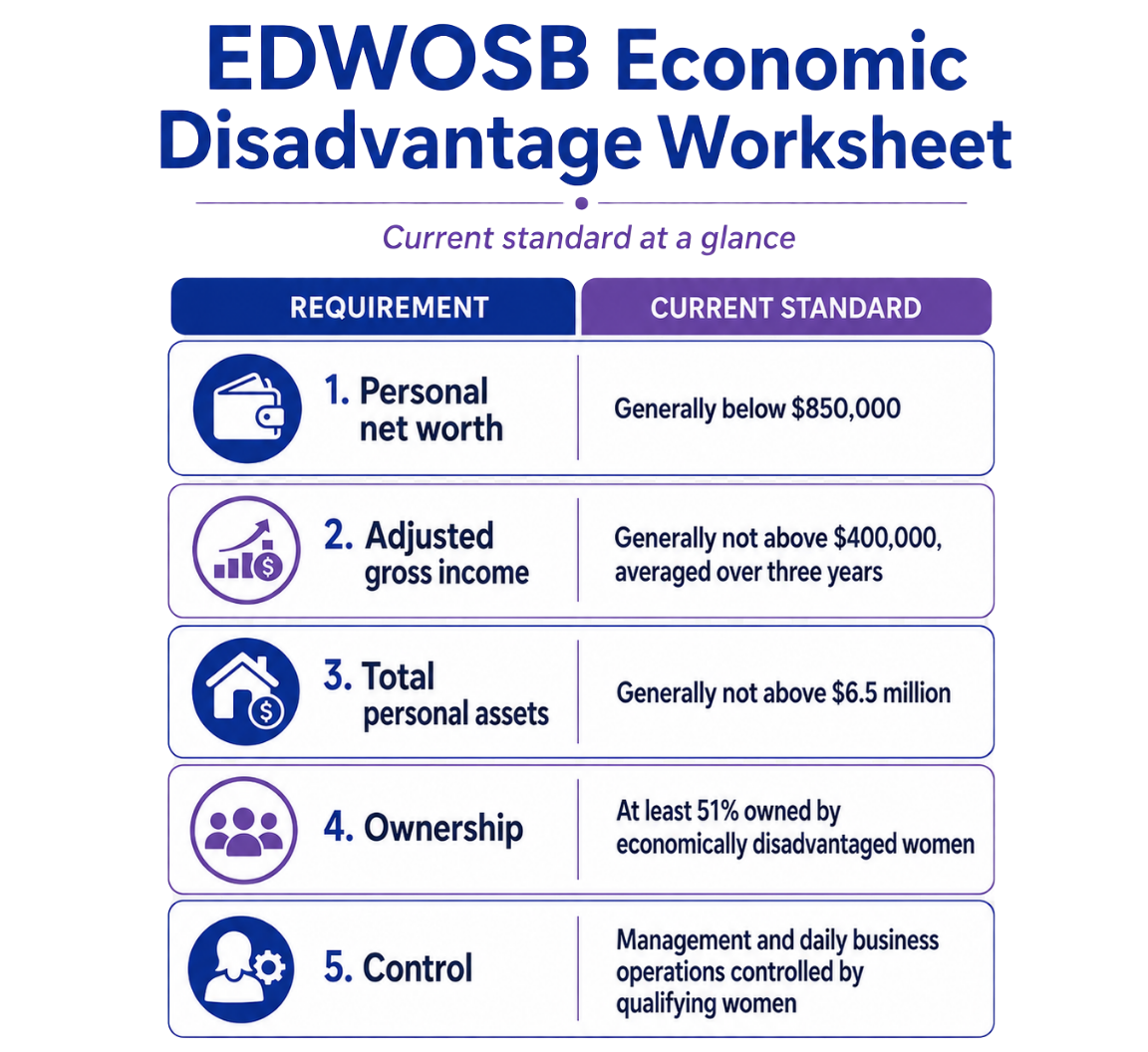
To qualify as an EDWOSB, a business must generally be at least 51% owned by one or more women who are economically disadvantaged. SBA rules evaluate economic disadvantage based on whether the owner’s ability to compete has been impaired because of diminished capital and credit opportunities.
Current EDWOSB financial thresholds include:
The EDWOSB rules include exclusions and special considerations, including treatment of ownership interest in the business, equity in a primary residence, retirement accounts, reinvested income, and certain spouse related financial circumstances.
This explains why tax returns matter. SBA is not asking for them because it enjoys paperwork confetti. It is checking whether the qualifying owner still fits within the economic-disadvantage box.
Why EDWOSB Firms Should Treat This as Urgent
If an EDWOSB firm received an SBA examination notice, the reported June 30, 2026 response deadline should be treated as urgent. A missed response can create more than administrative friction. It can create eligibility risk.
Under 13 CFR 127.405, if SBA proposes a WOSB or EDWOSB for decertification, the firm must respond in writing within 20 calendar days. The regulation also allows SBA to draw an adverse inference if a concern fails to cooperate or provide requested information.
That is the compliance equivalent of leaving the courtroom before your case is called.
What Happens If a WOSB or EDWOSB Is Decertified?
Decertification can hit a contractor’s pipeline quickly.
If a firm is decertified, it may lose the ability to represent itself as a WOSB or EDWOSB for WOSB or EDWOSB set-aside contracts. It may also need to notify contracting officers if it has already certified its status for a pending procurement and update its status in federal systems.
Potential Consequences of Decertification
Loss of WOSB or EDWOSB set aside eligibility
Disruption to pending bids and proposals
Increased risk in teaming agreements
Loss of prime contractor confidence
Potential award challenges
Required updates to SAM.gov or SBA certification records
Greater scrutiny during future certification reviews
For small businesses, decertification is not a minor paperwork bruise. It can change the competitive field overnight.
Why Prime Contractors Should Pay Attention
This is not only a small business problem.
Prime contractors often build capture strategies around socioeconomic partners. A prime may rely on an 8(a), WOSB, or EDWOSB teammate to support a set aside strategy, strengthen a subcontracting plan, or satisfy customer expectations. If that partner’s status changes midstream, the prime may face proposal risk, performance risk, or customer confidence risk.
Prime contractors should verify teammate certification status before proposal submission, not six months ago, not last fiscal year, and not “when we first met at that networking breakfast.” Certification diligence should be current, documented, and repeated at key points in the capture process.
Compliance Checklist for 8(a), WOSB, and EDWOSB Contractors
8(a) Applicant Checklist
Review SBA’s June 11, 2026 proposed rule.
Track the July 13, 2026 comment deadline.
Build a documented social disadvantage evidence file.
Connect evidence to personal economic harm.
Preserve court decisions, official findings, policies, reports, and records showing lost opportunities.
Review pending application materials for consistency with the proposed standard.
Consult qualified legal or compliance counsel before submitting sensitive eligibility narratives.
Current 8(a) Participant Checklist
Monitor the final rule and SBA implementation guidance.
Maintain annual review documentation.
Preserve original eligibility evidence.
Track material changes in ownership, control, or economic status.
Prepare for possible future documentation requests.
Communicate carefully with prime partners and contracting officers if status questions arise.
EDWOSB Checklist
Confirm whether the firm received an SBA examination notice.
Gather three years of personal and business tax returns.
Review personal net worth, adjusted gross income, and total asset calculations.
Document exclusions such as business equity, primary residence equity, and retirement accounts.
Review spouse related financial support or business involvement.
Confirm ownership and control documentation.
Respond by the stated deadline if SBA issued a notice.
Prime Contractor Checklist
Verify teammate certification status before proposal submission.
Check SAM.gov and SBA certification records.
Require prompt notice of certification reviews, protests, proposed decertification, or material eligibility changes.
Avoid relying on outdated certification screenshots.
Reassess capture strategies that depend on a single socioeconomic designation.
Build backup teaming options where eligibility is mission critical.
Implications for Federal Contractors
The immediate procurement risk is that socioeconomic status may become more contestable, more document dependent, and more closely watched.
For 8(a) applicants, the proposed rule could raise the burden of proof and increase the time needed to prepare an application. For current 8(a) participants, the short term impact may be limited, but the direction of travel is clear: SBA wants stronger files and more defensible eligibility decisions. For EDWOSB firms, the reported program examination creates immediate document-production pressure if the firm received an SBA notice.
For prime contractors, this is a teaming risk issue. A partner’s certification status should be treated like insurance, bonding, facility clearance, or key person availability: important enough to verify before it becomes a problem.
Implications for Agencies and Contracting Officers
Contracting officers may also need to pay closer attention to certification status during acquisition planning and award decisions.
Agency teams should watch for:
Changes in SBA certification status
Pending eligibility reviews or decertification proceedings
Status timing between proposal submission and award
Set aside eligibility questions
8(a) sole source eligibility issues
Subcontracting plan reliance on WOSB, EDWOSB, or 8(a) firms
If SBA scrutiny increases, agencies may see more questions from offerors, disappointed bidders, and internal counsel about whether a firm’s status was valid at the right point in the procurement.
Confirmed vs. Developing Information
Confirmed
SBA published a proposed rule on June 11, 2026, to remove the rebuttable presumption of social disadvantage for individually owned 8(a) firms. The proposed rule is associated with docket SBA-2026-0133 and RIN 3245-AI75, and comments are due July 13, 2026.
Confirmed
The proposed 8(a) rule does not amend or affect entity owned 8(a) firms, including firms owned by tribes, Alaska Native Corporations, Native Hawaiian Organizations, or Community Development Corporations.
Confirmed
Current EDWOSB eligibility requirements are set out in 13 CFR 127.203, and WOSB/EDWOSB decertification procedures are addressed in 13 CFR 127.405.
Developing
Federal News Network reported that SBA is conducting an EDWOSB program examination with responses due June 30, 2026. That reporting is credible and procurement-relevant, but contractors should rely on direct SBA communications for firm-specific instructions and deadlines.
Frequently Asked Questions
What is SBA changing in the 8(a) program?
SBA is proposing to remove the rebuttable presumption of social disadvantage for individually owned 8(a) applicants. Applicants would need to provide verifiable, fact-based evidence that they experienced social disadvantage resulting in material economic harm.
Does the proposed 8(a) rule affect tribal or ANC-owned 8(a) firms?
No. SBA states that the proposed rule does not amend or affect entity owned 8(a) firms, including firms owned by tribes, Alaska Native Corporations, Native Hawaiian Organizations, or Community Development Corporations.
When are comments due on SBA’s proposed 8(a) rule?
Comments are due July 13, 2026, according to the Federal Register notice.
What is the EDWOSB audit?
Federal News Network reported that SBA sent program examination emails to EDWOSB firms requesting survey responses and three years of personal and business tax returns by June 30, 2026.
What financial thresholds apply to EDWOSB owners?
Current SBA rules generally require the economically disadvantaged woman owner to have personal net worth below $850,000, adjusted gross income generally not above $400,000 averaged over three years, and total personal assets generally not above $6.5 million, subject to exclusions and special rules.
What happens if an EDWOSB is decertified?
A decertified firm may lose eligibility for WOSB or EDWOSB set-aside contracts, may need to notify contracting officers on pending procurements, and may need to update its certification status. SBA rules also provide that firms proposed for decertification generally have 20 calendar days to respond.
Should prime contractors care about this?
Yes. Prime contractors relying on 8(a), WOSB, or EDWOSB teammates should verify current certification status and require prompt notice of SBA reviews, protests, proposed decertification, or material eligibility changes.
The Bottom Line
The old mindset was: get certified, put the logo on the slide deck, and pursue the work.
The new mindset should be: get certified, maintain the file, monitor the rules, document the facts, and verify status before every major procurement milestone.
SBA’s 2026 actions signal a more rigorous compliance environment for federal small business certifications. For 8(a) firms, the proposed rule could reshape how social disadvantage is proven. For EDWOSB firms, the reported examination activity highlights the importance of current financial documentation. For primes and agencies, certification status is becoming a live risk factor in procurement strategy.
In federal contracting, paperwork is rarely glamorous. But right now, the best business development tool in your office may be a clean, current, audit ready certification file.
Source Reliability Summary
This article relies primarily on official government sources, including the Federal Register, SBA, and eCFR, for rulemaking and regulatory requirements. The EDWOSB audit details come from Federal News Network, a reputable federal procurement trade publication. SBA’s press release is used to describe the agency’s stated position and is treated as an official but policy-framed source.
Source count: 4 primary government sources, 1 reputable trade source, 0 opinion sources used as authority.
Executive Takeaways
Small-business contractors should treat 8(a), WOSB, and EDWOSB status as active compliance obligations, not static credentials. The immediate action items are to update certification files, verify teaming partner status before proposal submission, respond promptly to SBA examination notices, and monitor the 8(a) rulemaking before the July 13, 2026 comment deadline.
If you want to focus on your business while winning government contracts, reach out to our team and let’s see how we can win together!