Best FY2027 Federal Contracting Markets | 12 Capture Priorities
The federal budget tells you where Washington is putting money.
It does not tell you where your company should put its capture resources.
That distinction matters.
A $20 billion federal program may primarily fund grants, benefits, salaries, or transfers to states. A $2 billion modernization initiative, on the other hand, may depend heavily on contractors for software, engineering, cybersecurity, construction, integration, professional services, equipment, and program management.
For government contractors, budget size is therefore only one part of the opportunity.
After reviewing the FY2027 President's Budget, agency Congressional Justifications, acquisition forecasts, modernization initiatives, procurement activity, USAspending records, and federal small business contracting performance, Squared Compass identified 12 federal markets that deserve particular attention heading into FY2027.
And this time, we scored them.
The Squared Compass FY2027 Capture Opportunity Score
The Squared Compass Capture Opportunity Score is a 100 point framework designed to measure something more useful than agency budget size.
It asks: How attractive is this market to a government contractor actually deciding where to invest limited capture resources?
Each market is scored across five dimensions:
Squared Compass FY2027 Capture Opportunity Score
A score is not a prediction that your company will win.
It is also not a substitute for company specific capture analysis.
A 97 point market where your company has no relevant past performance may be a far worse target than a 76 point market where you have strong customer relationships, the right vehicle, an expiring incumbent contract, and directly relevant experience.
The score answers a different question:
Where does the federal market itself appear most favorable for contractor capture in FY2027?
A Note on Historical Federal Contract Spending
We deliberately did not publish a single supposed "market size" dollar amount beside every market.
There is a reason.
USAspending data can include multiyear contract structures, indefinite delivery vehicles, Management and Operating contracts, modifications, and other award structures that can make an award's reported value very different from annual contractor addressable spending.
DOE is the clearest example. Approximately 80 percent of DOE's annual procurement base flows through Management and Operating contractors, meaning both direct federal awards and second tier procurement activity matter when measuring the market.
Instead of manufacturing false precision, our Historical Contract Depth score considers recurring contract activity, major contract structures, agency procurement patterns, USAspending evidence, and small business contracting data.
Where official spending numbers provide meaningful context, we use them.
For example, VA reported that SDVOSBs alone received $10.2 billion in FY2024, representing 23 percent of VA prime contract dollars. That implies a VA prime contracting base of roughly $44 billion before even considering subcontracting activity.
DOE has reported reaching an $11 billion milestone in small business prime contracting awards, while its procurement model channels an enormous share of acquisition activity through laboratory and facility Management and Operating contractors.
The goal is therefore not to make every market look artificially precise.
It is to distinguish genuinely deep federal contracting markets from programs whose large budgets mostly flow somewhere other than procurement.
FY2027 Federal Contracting Markets at a Glance
*SBA grades are agency level indicators, not proof that every procurement within the agency will be available to small businesses. The FY2025 SBA scorecard graded GSA A+, most of the agencies on this list A, and NASA and SSA B.
What Changed When We Added the Data?
One ranking changed significantly.
GSA moved from No. 11 in our initial qualitative analysis to No. 6.
Why?
Because once we looked beyond GSA's unusual net budget presentation, the contracting picture became much stronger.
GSA's FY2027 request includes approximately $1.78 billion for Repairs and Alterations, $5.84 billion for rental of space, $2.87 billion for building operations, and more than $10.5 billion in new obligational authority through the Federal Buildings Fund. GSA also has an identifiable FY2027 capital prospectus pipeline containing repair, modernization, construction, acquisition, optimization, security, and leasing projects.
GSA then earned the highest FY2025 SBA procurement score of any agency in our top 12, at 145.07 percent.
That is exactly why we wanted a scoring framework.
Budget headlines alone would have undervalued the market.
1. Defense Modernization and the Defense Industrial Base
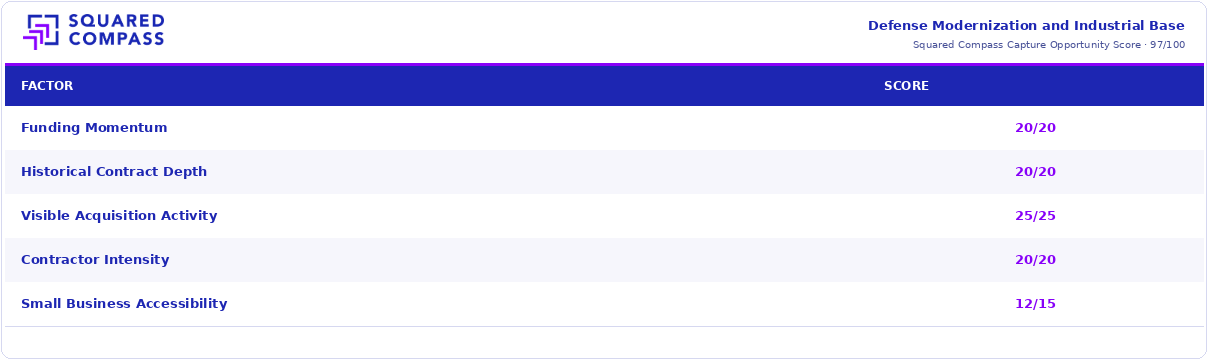
Squared Compass Capture Opportunity Score: 97/100
Why It Ranks First
Nothing else in the FY2027 federal market approaches the scale of the proposed defense expansion.
The FY2027 Department of War investment request includes approximately $413.1 billion for procurement and $343.7 billion for Research, Development, Test and Evaluation, totaling approximately $756.8 billion in investment accounts alone.
The request also includes:
$53.6 billion for autonomous systems and Drone Dominance.
$16.9 billion specifically to procure unmanned systems.
$14.4 billion for counter unmanned systems.
Major investments in munitions.
Shipbuilding.
Space.
Cyber.
Golden Dome missile defense.
Nuclear modernization.
Industrial production capacity.
The Procurement Signal Is Already Visible
This is not merely a budget proposal waiting for procurement activity.
The Drone Dominance Program invited 25 vendors into its initial competition. The first phase was structured to generate approximately $150 million in prototype delivery orders, with the broader initiative intended to place hundreds of thousands of weaponized small drones into the force by 2027.
The Department also awarded a $22.9 billion Navy contract to Raytheon in August 2026 to accelerate Tomahawk missile production.
The acquisition strategy increasingly includes multiyear agreements, minimum production quantities, alternative suppliers, rapid competitive evaluations, and stronger demand signals intended to encourage industry investment.
FY2027 Contractor Opportunity Areas
Autonomous systems.
Drones.
Counter UAS.
Missile defense.
Munitions.
Shipbuilding.
Shipyard infrastructure.
Space.
Command and control.
Artificial intelligence.
Cybersecurity.
Zero Trust.
Advanced manufacturing.
Critical minerals.
Supply chain resilience.
Testing and evaluation.
Systems engineering.
Installation modernization.
Logistics.
Production equipment.
Professional and technical services.
Small Business Accessibility
The Department of War earned an A, 100.46 percent, on SBA's FY2025 Small Business Procurement Scorecard. The Department also publicly identifies small and midsized firms as part of the industrial base expansion strategy.
That does not make every major weapons program accessible as a small business prime.
For many firms, the better path will be:
Subcontracting.
Supplier relationships.
Mentor protégé structures.
Joint ventures.
SBIR and STTR transition.
OTA pathways.
Prototype competitions.
Component and subsystem requirements.
Specialized professional or engineering services.
Capture Takeaway
Capture priority: Exceptional
Do not interpret this opportunity as "go chase DoW."
Defense is too large for that.
Identify the two or three capability areas where your company has an actual right to compete, then map the program offices, primes, vehicles, acquisition pathways, and supplier ecosystem surrounding those programs.
2. FAA Air Traffic Control Modernization
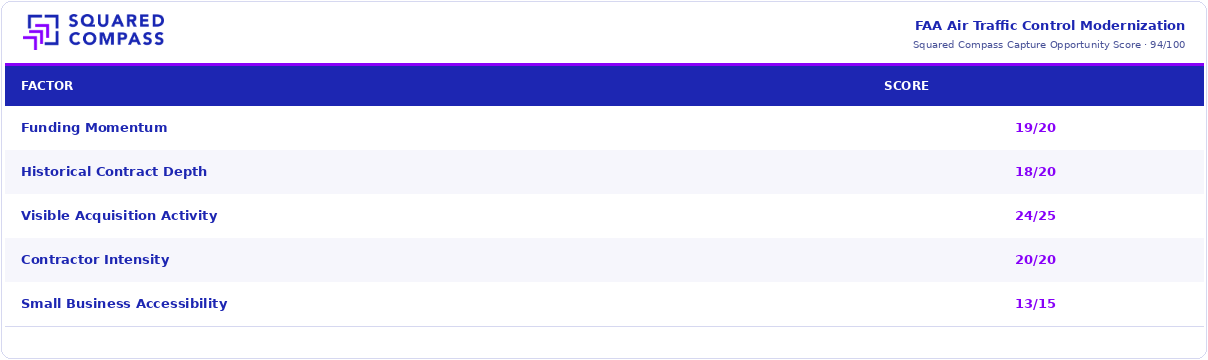
Squared Compass Capture Opportunity Score: 94/100
Why FAA Ranks This High
FAA modernization may be the strongest large scale civilian contracting market heading into FY2027.
The government is replacing physical and digital infrastructure across the National Airspace System.
FAA's FY2027 Congressional Justification contains active capital programs, named prime contractors, baseline costs, revised estimates, deployment schedules, and milestones extending through FY2027 and beyond.
Examples include communications modernization, Notice to Airmen modernization, surveillance systems, telecommunications, automation, and other National Airspace System investments.
FY2027 Contractor Opportunity Areas
Telecommunications.
Radar.
Surveillance.
Air traffic management software.
Systems engineering.
Systems integration.
Cybersecurity.
Cloud.
Data.
Automation.
Weather systems.
Towers.
TRACON facilities.
Construction.
Network infrastructure.
Testing.
Program management.
Operations and maintenance.
The Procurement Signal
DOT has established a dedicated FY2027 Procurement Opportunity Forecast.
Beginning with FY2026, FAA and other DOT forecast opportunities are also being published through the federal Acquisition Gateway Forecast Tool.
That means contractors have both budget level visibility and acquisition forecast visibility.
This is an important distinction.
Many supposed "growth markets" have a budget narrative but little visible procurement activity.
FAA has both.
Why Contractors Should Pay Attention
Air traffic control is mission critical infrastructure.
FAA cannot simply decide that telecommunications, surveillance, radar, automation, weather systems, and controller technology are no longer necessary.
Many systems also involve long implementation periods and complex integration with existing National Airspace System infrastructure.
That creates recurring opportunities for:
Engineering.
Integration.
Sustainment.
Testing.
Cybersecurity.
Construction.
Software modernization.
Telecommunications.
Program management.
Small Business Accessibility
DOT earned an A, 100.87 percent, on SBA's FY2025 procurement scorecard.
The challenge is that the largest FAA modernization programs frequently involve entrenched systems integrators and highly specialized aviation requirements.
Small businesses therefore need to distinguish between:
programs where they can realistically prime,
requirements suitable for set asides, and
major modernization programs where subcontract positioning is the better strategy.
Capture Takeaway
Capture priority: Exceptional
For technology, telecom, aviation, construction, engineering, cybersecurity, and systems integration companies, FAA warrants a dedicated account and program level capture strategy.
3. VA Electronic Health Record and Healthcare Technology
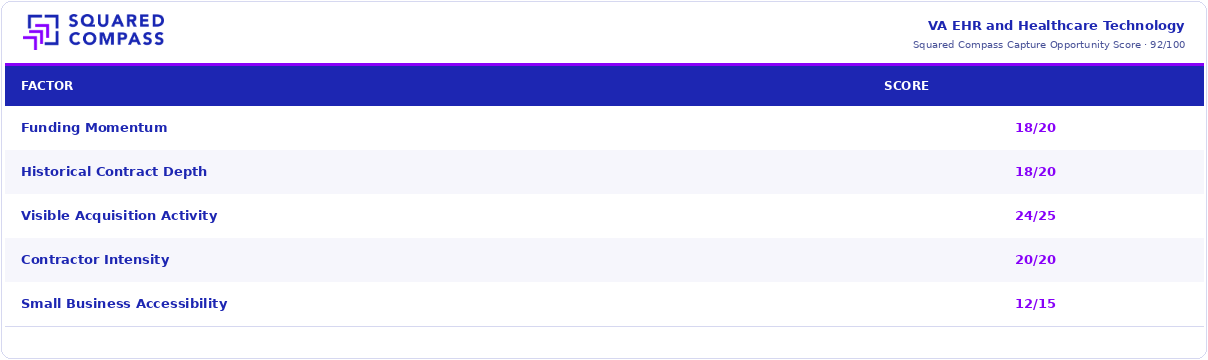
Squared Compass Capture Opportunity Score: 92/100
Why VA Ranks Third
VA is not merely planning healthcare modernization.
It is deploying it.
For FY2027, VA requests:
$2.768 billion for Electronic Health Record Modernization.
$745 million for Infrastructure Readiness.
$727 million for the Program Management Office.
VA describes 28 medical center implementations during FY2027 and identifies requirements involving hosting, testing, help desk support, training, change management, data, cloud, identity, integration, cybersecurity, infrastructure, and program management.
FY2027 Contractor Opportunity Areas
EHR deployment.
Healthcare IT.
Systems integration.
Data migration.
Cloud.
Cybersecurity.
Identity.
Network modernization.
End user devices.
Training.
Change management.
Interface development.
Help desk.
Infrastructure.
Program management.
Healthcare technology.
Historical Contracting Depth
VA is already a deep procurement market.
In FY2024, VA reported awarding $10.2 billion to SDVOSBs alone, equal to 23 percent of its total prime contract dollars.
That implies approximately $44 billion in overall VA prime contract dollars for the period.
That scale matters because EHR modernization is occurring inside an agency that already possesses a mature healthcare, technology, construction, professional services, and supply contracting ecosystem.
Why This Is More Than an Oracle Opportunity
The core EHR contract is a single award IDIQ.
But VA's own Technology Acquisition Center describes the scope as encompassing project management, training, testing, deployment, sustainment, hosting, software, hardware, and other EHR requirements.
The larger opportunity also includes infrastructure and adjacent systems that must be ready before each deployment.
That creates work around the platform, not just inside it.
Small Business Accessibility
VA earned an A, 109.21 percent, on the FY2025 SBA scorecard.
VA's Veterans First acquisition environment also gives veteran owned companies an unusually important role.
The reason we did not score Small Business Accessibility even higher is specific to this market: some of the largest EHR work remains concentrated under existing enterprise contract structures.
Capture Takeaway
Capture priority: Exceptional
Companies should map EHR deployment by site, infrastructure need, acquisition center, incumbent, vehicle, and implementation schedule rather than simply searching SAM.gov for "EHR."
4. DOE/NNSA Nuclear Security, AI, and Advanced Computing
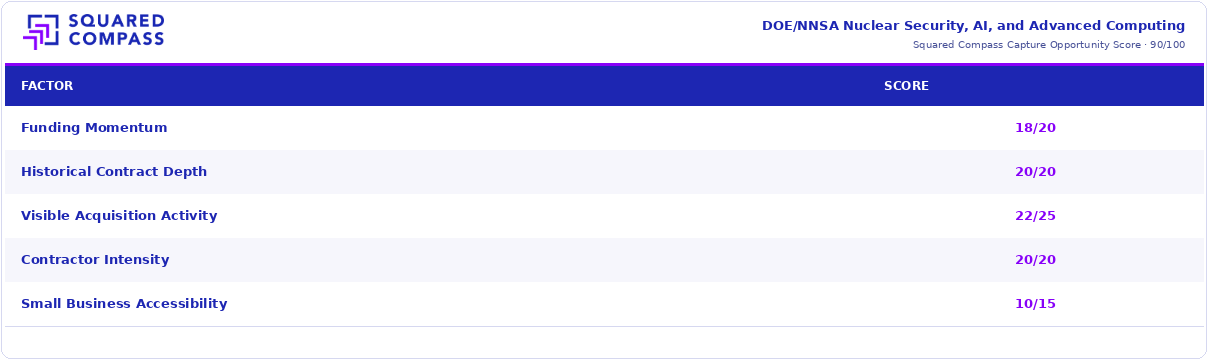
Squared Compass Capture Opportunity Score: 90/100
Why DOE/NNSA Ranks Fourth
DOE's relatively flat department topline conceals one of the strongest contractor markets in government.
NNSA alone receives approximately $32.8 billion in the FY2027 request.
DOE is simultaneously investing in:
Nuclear security.
Weapons modernization.
National Laboratories.
Artificial intelligence.
High performance computing.
Quantum.
Advanced nuclear technology.
Critical minerals.
Cybersecurity.
Scientific infrastructure.
Historical Contractor Depth
DOE states that approximately 80 percent of its annual procurement base is allocated through Management and Operating contractors responsible for laboratories and major federal facilities.
That changes how contractors should analyze DOE.
The addressable market exists at two levels:
Federal prime acquisition
and
Procurement performed by DOE's M&O contractors.
Ignoring either side produces an incomplete market picture.
DOE has also reported reaching approximately $11 billion in small business prime contracting awards in recent procurement performance.
FY2027 Contractor Opportunity Areas
Nuclear engineering.
Nuclear facilities.
Construction.
Environmental management.
High performance computing.
Artificial intelligence.
Data centers.
Scientific computing.
Cybersecurity.
Critical minerals.
Advanced manufacturing.
Laboratory operations.
Engineering.
Scientific equipment.
Program management.
Visible Acquisition Activity
DOE maintains an acquisition forecast updated monthly and separately identifies headquarters, field office, construction, laboratory, and facility management opportunities.
DOE also notes that its DOE/NNSA construction opportunity listing is being updated for October 2026, directly ahead of FY2027.
Small Business Accessibility
DOE earned an A, 109.28 percent, on SBA's FY2025 scorecard.
But small business access deserves a qualification.
A tremendous share of the market sits behind M&O contractors.
That means an effective DOE capture strategy must include both government acquisition organizations and the large organizations operating laboratories and sites.
Capture Takeaway
Capture priority: Very Strong
DOE/NNSA is particularly attractive for nuclear, engineering, construction, scientific computing, AI infrastructure, facilities, cybersecurity, and advanced technology companies.
5. DHS Cybersecurity and Operational Technology
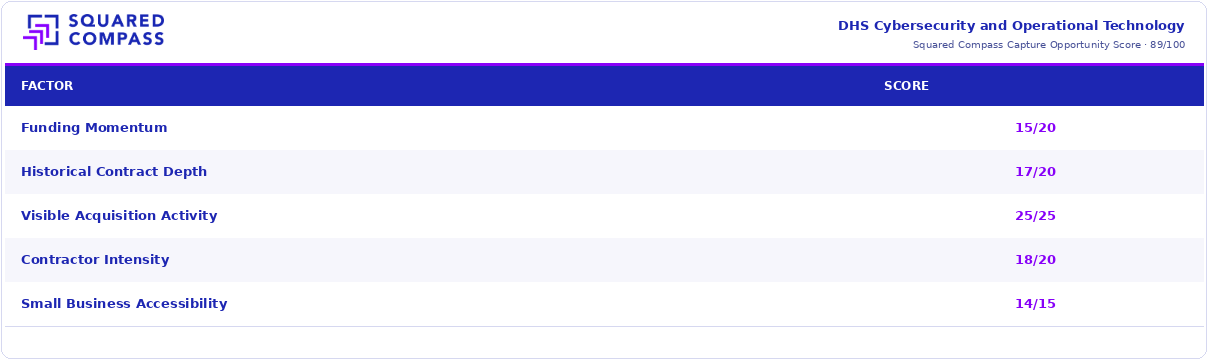
Squared Compass Capture Opportunity Score: 89/100
Why DHS Makes the Top Five
DHS has perhaps the strongest visible FY2027 acquisition evidence of any civilian agency we reviewed.
CISA's Acquisition Planning Forecast System already identifies FY2027 requirements with estimated values, acquisition strategies, vehicles, incumbents, solicitation dates, and anticipated award quarters.
That is exactly the kind of information capture teams should want.
Representative FY2027 Procurements
Cyber Technology Services
CISA forecasts a new requirement valued above $100 million supporting IT architecture, DevOps, SecOps, operations and maintenance, incident response, and proactive threat hunting.
Estimated solicitation: May 2027.
Anticipated award: Q4 FY2027.
CISA Cybersecurity Operations Support Services
CISA also forecasts a follow on cybersecurity operations requirement valued above $100 million.
The requirement includes SOC operations, vulnerability management, penetration testing, security engineering, cloud security, AI security, purple team activity, and electronic discovery.
Estimated solicitation: October 2026.
Anticipated award: Q2 FY2027.
Foreign Investment Risk Analysis
Another CISA requirement is forecast as an 8(a) procurement valued between $2 million and $5 million, with an anticipated Q2 FY2027 award.
This is why DHS scores 25 out of 25 for visible acquisition activity.
FY2027 Contractor Opportunity Areas
Cybersecurity.
Threat hunting.
SOC.
Security engineering.
DevSecOps.
Cloud.
Border technology.
Identity.
Software.
Data.
Critical infrastructure.
Training.
Communications.
Systems integration.
Operational support.
Small Business Accessibility
DHS earned an A, 108.42 percent, on SBA's FY2025 scorecard.
More importantly, the forecast itself shows actual small business acquisition strategies.
Current CISA records include:
Small business set asides.
WOSB opportunities.
8(a) acquisitions.
OASIS+.
NASA SEWP.
8(a) STARS III.
GSA Schedule acquisitions.
Capture Takeaway
Capture priority: Very Strong
DHS is particularly attractive because the procurement evidence is not hypothetical.
Contractors can already identify requirements, dates, vehicles, set aside strategies, incumbent information, and acquisition contacts.
That is actionable capture intelligence.
6. GSA Federal Real Estate and Governmentwide Shared Services
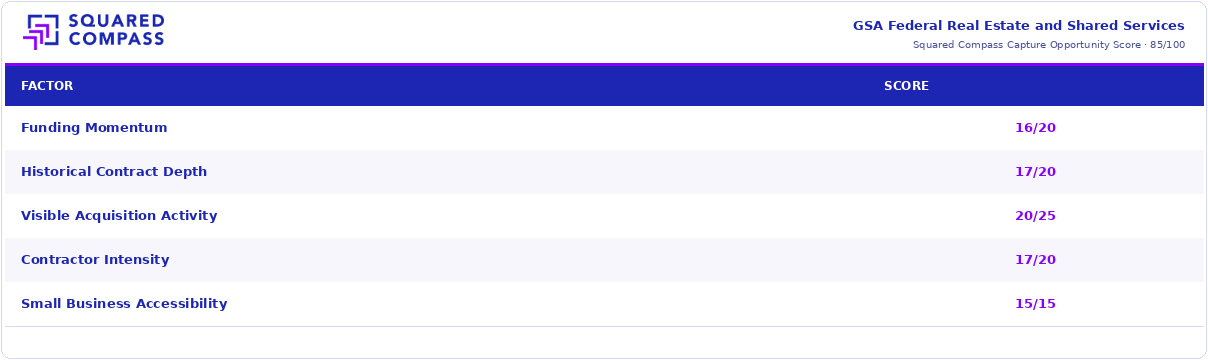
Squared Compass Capture Opportunity Score: 85/100
Why GSA Moved Up
Our initial qualitative ranking placed GSA at No. 11.
The data changed our view.
GSA's FY2027 Federal Buildings Fund request includes:
Approximately $1.78 billion for Repairs and Alterations.
Approximately $5.84 billion for Rental of Space.
Approximately $2.87 billion for Building Operations.
Approximately $10.56 billion in new obligational authority.
GSA also maintains a dedicated FY2027 prospectus pipeline.
Projects include federal building renovations, courthouse projects, optimization efforts, security programs, leases, construction, remediation, and modernization across multiple states.
FY2027 Contractor Opportunity Areas
Construction.
Repairs and alterations.
HVAC.
Electrical.
Plumbing.
Building systems.
Life safety.
Facilities.
Architecture.
Engineering.
Federal leases.
Energy.
Digital services.
Cloud.
Identity.
Data.
Shared services.
Acquisition support.
A Much Larger Pipeline Sits Behind the Immediate FY2027 List
In September 2026, GSA transmitted 103 additional prospectus level capital project fact sheets to Congress representing approximately $10 billion in projected repair and modernization requirements across FY2028 through FY2034.
The list includes roofing, elevators, HVAC, fire alarms, water damage, hazardous material remediation, seismic work, electrical systems, plumbing, and structural repairs.
For contractors, that makes FY2027 important not just as an execution year, but as a capture year for the capital pipeline behind it.
Small Business Accessibility
GSA received an A+, 145.07 percent, the strongest FY2025 SBA score among the agencies in our top 12.
Why GSA Still Does Not Rank Higher
GSA's market is fragmented.
A contractor selling cloud services, a general contractor renovating federal buildings, and a company pursuing MAS or OASIS+ opportunities are all technically participating in the GSA ecosystem, but they are competing in very different markets.
GSA must therefore be broken into specific capture lanes.
Capture Takeaway
Capture priority: Very Strong
For construction, AEC, facilities, building systems, real estate, federal shared services, and governmentwide acquisition companies, GSA deserves significantly more attention than the agency's headline net appropriation would suggest.
7. DOJ Law Enforcement and Immigration Systems
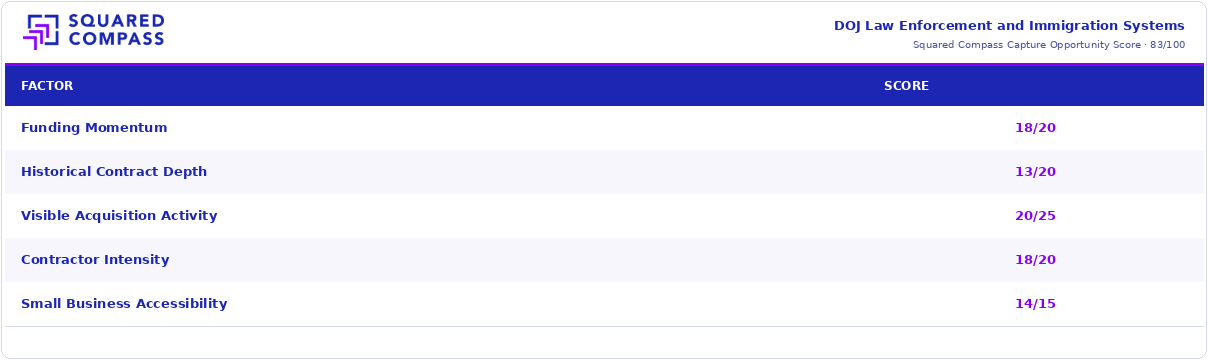
Squared Compass Capture Opportunity Score: 83/100
Why DOJ Is Moving Up
DOJ is one of FY2027's strongest civilian budget growth stories.
The contractor opportunity includes:
Law enforcement systems.
Case management.
Investigative technology.
Data analytics.
Cybersecurity.
Courtroom systems.
Immigration case processing.
Corrections.
Healthcare.
Facilities.
Communications.
Information sharing.
Professional services.
Procurement Visibility
DOJ now operates a Forecast of Contracting Opportunities dashboard covering planned procurements for FY2026 and beyond.
The forecast includes anticipated contract actions exceeding $250,000 and is scheduled for quarterly updates.
That improves the market's capture value because contractors can connect budget growth to planned buying activity.
Small Business Accessibility
DOJ earned an A, 108.46 percent, on SBA's FY2025 procurement scorecard.
DOJ also includes many buying organizations with very different contracting patterns:
FBI.
DEA.
ATF.
U.S. Marshals.
Bureau of Prisons.
EOIR.
Justice Management Division.
The correct capture strategy is therefore component specific.
Capture Takeaway
Capture priority: Strong
DOJ deserves additional attention from federal IT, data, security, facilities, corrections support, healthcare, law enforcement technology, and professional services contractors.
8. NASA Artemis and Commercial Space
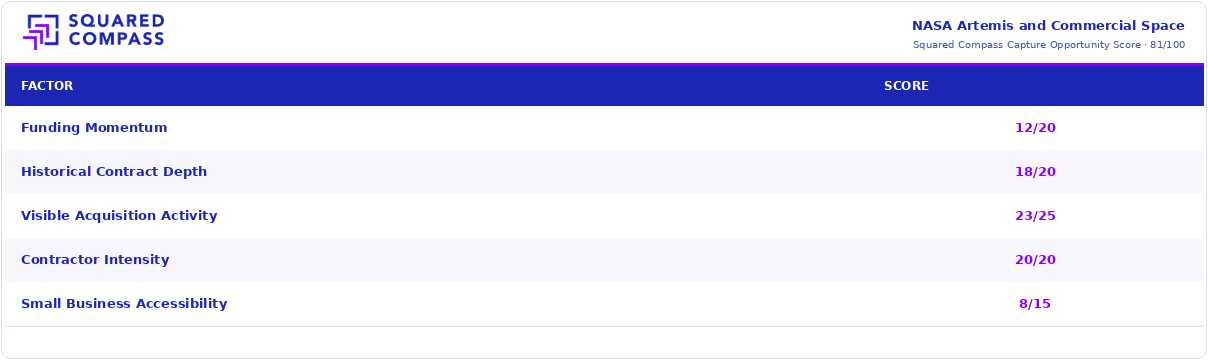
Squared Compass Capture Opportunity Score: 81/100
Why NASA Makes the List Despite a Budget Cut
NASA is the clearest example of why contractors should not rank markets by agency topline.
The overall NASA budget falls.
But contractor dependent exploration and commercial space programs continue moving.
NASA issued a draft RFP in July 2026 for the next phase of its Commercial Low Earth Orbit strategy, seeking commercially operated space station services as the agency transitions from the International Space Station.
NASA's Commercial LEO Development acquisition schedule anticipates a final RFP in 2026 and an award in spring 2027.
NASA's A-BOX procurement separately identifies a preliminary schedule with:
Final RFP: December 14, 2026.
Award: May 18, 2027.
Contract start: June 1, 2027.
FY2027 Contractor Opportunity Areas
Commercial space stations.
Lunar systems.
Space transportation.
Communications.
Robotics.
Mission systems.
Engineering.
Certification.
Testing.
Space infrastructure.
Commercial services.
Advanced manufacturing.
Science and technology.
Small Business Accessibility
NASA earned a B, 97.36 percent, on SBA's FY2025 scorecard.
The market also remains heavily concentrated in specialized aerospace firms and large prime contractors.
That is why NASA's small business accessibility score is lower even though the contracting intensity is extremely high.
Capture Takeaway
Capture priority: Strong, but specialized
NASA can be an exceptional target when your company has legitimate aerospace, engineering, scientific, manufacturing, software, or space systems capabilities.
It is a poor market to enter simply because "space is growing."
9. Indian Health Service Healthcare Modernization
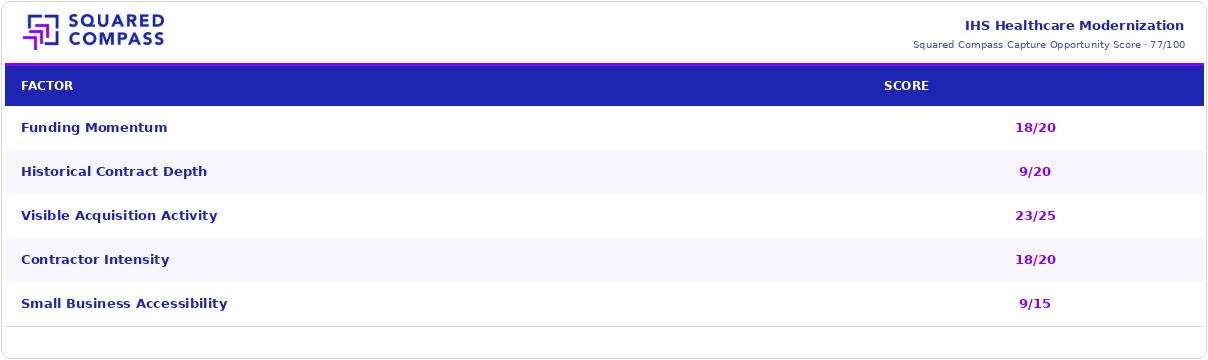
Squared Compass Capture Opportunity Score: 77/100
Why IHS Deserves Its Own Entry
The PATH Electronic Health Record modernization effort is significant enough to treat as a separate capture market from broader HHS.
The FY2027 request includes $287 million for IHS health IT modernization, an increase of $93 million.
IHS also requests approximately $191 million for healthcare facilities construction.
The Procurement Signal Is Explicit
The IHS FY2027 Congressional Justification says FY2027 funding will support additional task orders under the 10 year IDIQ contract for the EHR integrator and product solution.
FY2027 activities include:
Cloud hosting.
Software configuration.
Training.
Interfaces.
Integration testing.
Legacy data migration.
Site implementation.
Network modernization.
Hardware.
Infrastructure.
Legacy system stabilization.
Interoperability.
That is unusually clear budget to acquisition linkage.
The core integrator is GDIT using Oracle Health technology.
FY2027 Contractor Opportunity Areas
EHR.
Health IT.
Cloud.
Hosting.
Training.
Integration.
Cybersecurity.
Network infrastructure.
Site readiness.
Biomedical systems.
Data migration.
Interoperability.
Facilities.
Program management.
Why the Score Is Not Higher
The market is meaningful and growing, but the core EHR implementation is already organized around a major IDIQ integrator.
That constrains direct prime access.
Companies should therefore map:
GDIT subcontracting.
Site level acquisitions.
Hardware.
Infrastructure.
Network remediation.
Interoperability.
Training.
Tribal and Urban Indian implementation needs.
Capture Takeaway
Capture priority: Strong
PATH is a multiyear deployment market, but the right capture strategy is ecosystem based rather than simply pursuing the core EHR platform.
10. Interior Wildfire Operations and Federal Infrastructure
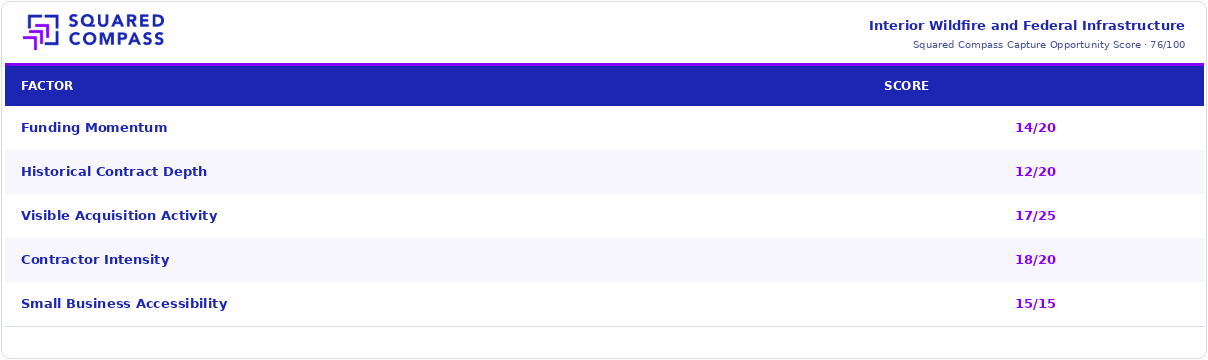
Squared Compass Capture Opportunity Score: 76/100
Why Interior Is an Emerging Market
Interior's overall budget declines.
But the Department is creating and operationalizing a new U.S. Wildland Fire Service.
The FY2027 budget documentation contains a dedicated U.S. Wildland Fire Service justification, and Interior was already issuing FY2027 implementation guidance by August 2026.
Potential Contractor Requirements
Aviation.
Aircraft maintenance.
Logistics.
Mapping.
Geospatial systems.
Fire intelligence.
Communications.
Equipment.
Vehicles.
Facilities.
Weather.
IT.
Training.
Emergency operations.
Construction.
Engineering.
Why Interior Scores Below IHS
The strategic signal is strong.
The procurement signal is less mature.
Interior's public procurement forecast page still prominently reflects FY2025 forecast materials rather than a fully developed FY2027 pipeline.
That does not mean procurements will not occur.
It means capture teams currently have less visibility into exact acquisition timing, contract values, and vehicles than they do at DHS, NASA, IHS, or FAA.
Small Business Accessibility
Interior earned an A, 113.85 percent, on the FY2025 SBA scorecard.
Wildland fire and natural resources also contain categories of work traditionally compatible with smaller and specialized contractors.
Capture Takeaway
Capture priority: Strong, Emerging
This is a market to begin positioning in now, particularly for aviation, emergency logistics, geospatial, communications, equipment, engineering, and wildfire technology companies.
But do not confuse an organizational announcement with a procurement forecast.
The next step is watching how the new organization actually buys.
11. Social Security Digital Modernization and Automation
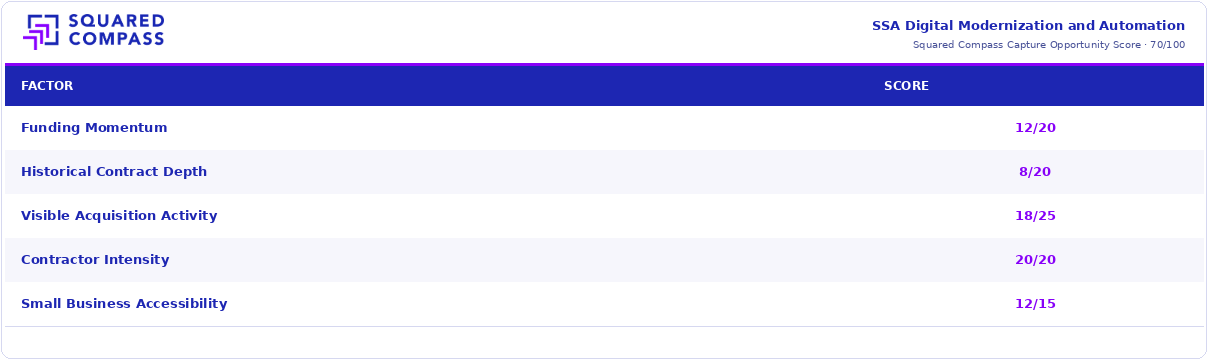
Squared Compass Capture Opportunity Score: 70/100
Why SSA Still Makes the List
SSA's direct contracting market is smaller than the markets above it.
Its modernization need is not.
SSA's mission requires the agency to:
Process claims.
Maintain beneficiary systems.
Secure sensitive information.
Operate public facing services.
Verify identity.
Prevent fraud.
Modernize legacy technology.
That creates continuing demand for:
Software modernization.
Cloud.
Cybersecurity.
Identity.
Automation.
Digital customer experience.
Data.
Fraud analytics.
Systems integration.
Procurement Visibility
SSA maintains a formal Forecast of Contract Opportunities covering anticipated acquisitions above the Simplified Acquisition Threshold that small businesses may perform directly or through subcontracting.
As of September 2026, SSA's public forecast page lists an FY2026 forecast but not yet a distinct FY2027 forecast.
That is why SSA scores lower for visible FY2027 acquisition activity than markets with already published FY2027 requirements.
Small Business Accessibility
SSA earned a B, 97.64 percent, on SBA's FY2025 scorecard.
Capture Takeaway
Capture priority: Selectively Strong
SSA is attractive for companies with strong federal digital modernization credentials.
But the smaller contract base means contractors should identify actual programs and forecast requirements before committing significant account resources.
12. Treasury Financial Systems, Cybersecurity, and Program Integrity
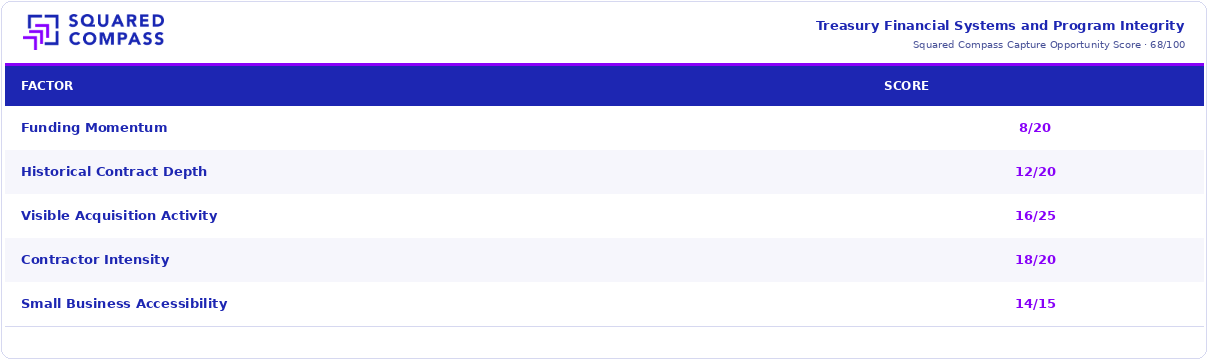
Squared Compass Capture Opportunity Score: 68/100
Why Treasury Still Makes the List
Treasury's budget declines.
Its core financial infrastructure still has to operate.
Treasury's FY2027 Congressional Justification separately identifies:
Cybersecurity Enhancement Account.
Department wide Systems and Capital Investments.
Terrorism and Financial Intelligence.
FinCEN.
Fiscal Service.
IRS.
Treasury Franchise Fund.
Shared technology services.
The Treasury Franchise Fund also describes continued FY2027 investments to strengthen cybersecurity and expand adoption of enterprise IT applications and shared services.
FY2027 Contractor Opportunity Areas
Federal payments.
Tax systems.
Financial systems.
Cybersecurity.
Fraud.
Financial intelligence.
Sanctions.
Identity.
Data analytics.
Cloud.
Automation.
Shared services.
Program integrity.
Procurement Visibility
Treasury maintains a Forecast of Contract Opportunities for anticipated actions above $250,000 that small businesses may perform either directly or through subcontracting.
However, the publicly surfaced forecast is still centered on FY2025 rather than a dedicated FY2027 forecast.
That reduces the market's current capture score.
Small Business Accessibility
Treasury earned an A, 104.24 percent, on SBA's FY2025 procurement scorecard.
Capture Takeaway
Capture priority: Selectively Strong
Treasury remains attractive for specialized fintech, cyber, data, fraud, identity, financial intelligence, and enterprise IT companies.
But this should generally be a targeted account strategy rather than a broad market play.
Markets We Would Approach More Selectively in FY2027
The scoring process also reinforces why several large federal budgets do not make the top 12.
Department of Education
Education controls tens of billions of federal dollars.
Much of that funding flows through grants and formula programs.
That can create an excellent downstream state and local education market without creating an equivalent federal prime contracting market.
HUD
The same issue appears at HUD.
Rental assistance and housing programs can be enormous while federal contractor addressable spend is concentrated in a much smaller set of activities such as:
FHA operations.
IT.
Housing inspections.
Program integrity.
Data.
Financial systems.
Grants administration.
NSF
NSF remains important for scientific and specialized research organizations.
But the FY2027 funding reduction requires a more selective strategy around protected areas such as:
AI.
Quantum.
Biotechnology.
Advanced manufacturing.
Major research facilities.
Scientific computing.
EPA
EPA's large budget reduction makes indiscriminate agency capture difficult.
Water cybersecurity, remediation, Superfund, permitting technology, environmental data, and core statutory programs remain more defensible targets.
SBA
SBA influences an enormous federal contracting market.
It is not itself an enormous federal contracting customer.
The bigger opportunity for most contractors is using programs administered by SBA to sell to other agencies.
Five Cross Government Markets That May Be Bigger Than Any Single Agency
Agency account plans are useful.
But several FY2027 markets cut across organizational boundaries.
Artificial Intelligence
AI appears across:
Defense.
DOE.
DHS.
SSA.
Treasury.
VA.
HHS.
NASA.
NSF.
Federal shared services.
And the federal AI opportunity is much larger than "build an AI model."
It includes:
Compute.
Cloud.
Data.
Networking.
Cybersecurity.
Integration.
Testing.
Governance.
Workflow redesign.
Sensors.
Edge systems.
Training.
Infrastructure.
Cybersecurity
Cybersecurity may be the most durable cross government market in the federal portfolio.
Budgets can decline.
Networks, identities, applications, cloud environments, classified systems, health records, financial systems, and critical infrastructure still need protection.
Critical Minerals and Supply Chains
Critical minerals intersect:
Defense.
DOE.
Interior.
Commerce.
International programs.
Opportunities extend into:
Mining.
Processing.
Supply chain analytics.
Engineering.
Manufacturing.
Research.
Logistics.
Environmental work.
Industrial infrastructure.
Federal Healthcare Technology
VA and IHS alone create significant modernization requirements.
Add:
Defense Health Agency.
Other HHS components.
Healthcare cybersecurity.
Data interoperability.
Cloud.
Medical logistics.
Digital health.
Federal healthcare technology becomes a substantial recurring contracting market.
Federal Infrastructure Modernization
Infrastructure opportunity cuts across:
FAA.
GSA.
Defense installations.
DOE laboratories.
VA medical facilities.
IHS healthcare facilities.
USACE.
Interior.
Wildfire infrastructure.
The opportunity spans architecture, engineering, construction, facilities, environmental services, equipment, controls, cyber physical systems, and program management.
How We Are Working with Partners to Allocate their FY2027 Capture Resources
When working with a contractor to allocate FY2027 pipeline resources, we would not simply ask which agencies match its NAICS codes or which solicitations are upcoming.
We would ask:
Which of these markets match capabilities the company can actually prove?
Does the company have relevant past performance?
Does it have access to the contract vehicles agencies are likely to use?
Are acquisitions visible in agency forecasts?
Which incumbents hold the existing work?
When do those contracts expire?
Is the requirement new, recompeting, consolidating, or expanding?
Is a small business set aside realistic?
Is the company better positioned as a prime or subcontractor?
Has the capture process started early enough to influence the opportunity?
That last question is critical.
A solicitation appearing on SAM.gov is often the end of the capture process, not the beginning.
The strongest FY2027 opportunities are already moving through acquisition planning, market research, budgeting, industry engagement, requirements development, and procurement forecasting.
How to Turn the Capture Opportunity Score Into an Actual Pipeline
The 97 point Defense market does not belong in everyone's pipeline.
Neither does FAA.
Neither does VA.
The score should first identify markets worth investigating.
Then we would apply a second layer that is entirely company specific.
A company's internal opportunity score should consider:
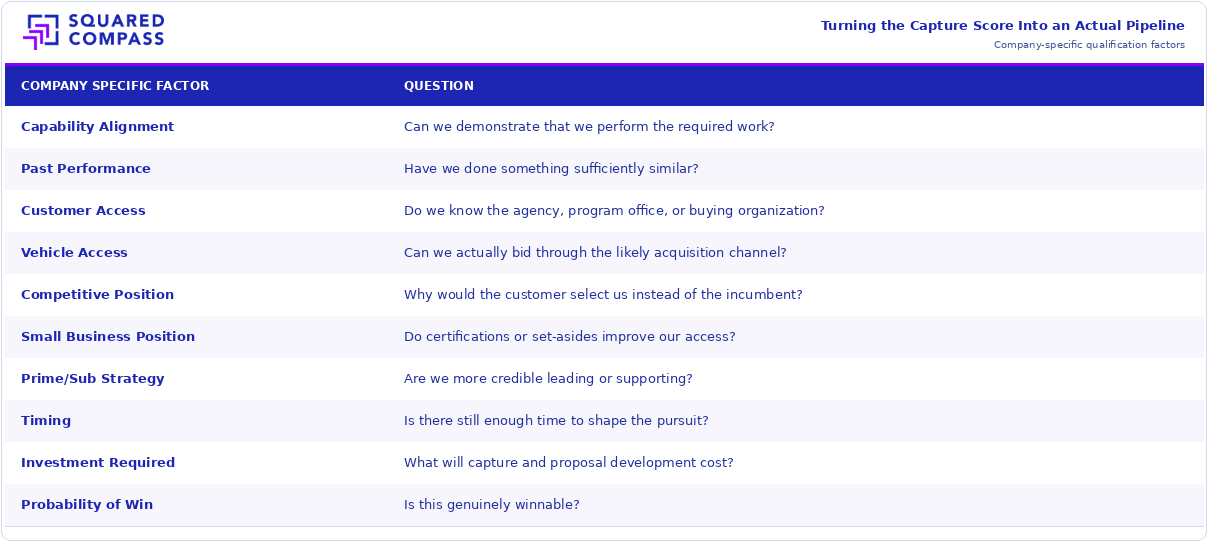
The two scores solve different problems.
Squared Compass Capture Opportunity Score: Is the market attractive?
Company Opportunity Score: Is this market attractive for you?
That second question is ultimately more important.
Budget Intelligence Is Only the Beginning
The FY2027 federal budget gives contractors an important signal.
But the budget does not tell you:
What will actually be contracted.
When the solicitation will release.
Which vehicle will be used.
Whether it will be set aside.
Who the incumbent is.
How the incumbent has performed.
When the current contract expires.
What the government bought last time.
Which program office owns the requirement.
Whether funding is annual or multiyear.
Whether your company has a realistic probability of winning.
That requires connecting budget intelligence to:
Agency acquisition forecasts.
USAspending.
FPDS historical data.
Contract expiration dates.
Incumbents.
Contract vehicles.
Sources sought notices.
RFIs.
Industry days.
Agency strategic plans.
Congressional appropriations.
Small business offices.
Program offices.
Prime contractor supplier ecosystems.
That is how a contractor moves from knowing where Washington is spending money to knowing where the company should spend its own money.
The FY2027 Capture Takeaway
If there is one lesson from the FY2027 budget, it is this:
Do not chase the biggest budget. Chase the intersection of funding, mission urgency, contractor dependency, acquisition activity, market access, and your ability to win.
For FY2027, that intersection appears particularly strong in:
Defense modernization and industrial base expansion.
FAA air traffic control modernization.
VA healthcare technology and EHR deployment.
DOE/NNSA nuclear security and advanced computing.
DHS cybersecurity and operational technology.
GSA federal real estate and shared services.
DOJ law enforcement technology.
NASA commercial space and exploration.
IHS healthcare modernization.
Federal wildfire operations.
SSA digital modernization.
Treasury financial systems and cybersecurity.
But the right FY2027 strategy is not to add 12 markets to your pipeline.
It is to find the two or three markets where your company has the strongest right to win.
Then determine:
The programs.
The buyers.
The vehicles.
The incumbents.
The partners.
The procurement timelines.
The acquisition signals.
The customer problems.
And start capture before everyone else is responding to the same RFP.
Frequently Asked Questions
What are the best federal contracting markets for FY2027?
Based on the Squared Compass FY2027 Capture Opportunity Score, the strongest markets are defense modernization, FAA air traffic control modernization, VA EHR and healthcare technology, DOE/NNSA nuclear security and advanced computing, and DHS cybersecurity.
How does Squared Compass rank federal contracting markets?
The Squared Compass Capture Opportunity Score evaluates funding momentum, historical contracting depth, visible FY2027 acquisition activity, contractor intensity, and small business accessibility.
The maximum score is 100.
Which federal contracting market ranks highest for FY2027?
Defense modernization and industrial base expansion ranks first with a Squared Compass Capture Opportunity Score of 97 out of 100.
The market combines historic investment, massive procurement activity, mission urgency, strong contractor dependency, and explicit efforts to increase industrial capacity.
What is the strongest civilian federal contracting market in FY2027?
FAA air traffic control modernization ranks as the strongest civilian federal contracting market in our analysis, scoring 94 out of 100.
VA EHR and healthcare technology follows closely at 92.
Which agencies have the strongest small business contracting performance?
Among the agencies included in this analysis, GSA received the highest FY2025 SBA procurement score at 145.07 percent.
Interior, VA, DOE, DHS, DOJ, Treasury, DOT, and the Department of War also earned A grades.
NASA and SSA received B grades.
Are there actual FY2027 procurements already visible?
Yes.
Examples include CISA Cyber Technology Services valued above $100 million with a Q4 FY2027 anticipated award, CISA Cybersecurity Operations Support Services valued above $100 million with a Q2 FY2027 anticipated award, NASA procurements with planned 2027 awards, additional IHS PATH EHR task orders, and DOT's FY2027 Procurement Opportunity Forecast.
Can agencies with declining budgets still be good contracting markets?
Yes.
NASA is one of the clearest examples.
Its agency budget declines while specific commercial space and exploration procurements continue moving through active acquisition milestones.
GSA demonstrates the opposite problem: its budget presentation can make the agency appear relatively small even though its underlying Federal Buildings Fund and capital pipeline create significant contractor activity.
How should small businesses use this ranking?
Use the ranking to identify attractive markets, then examine:
Agency SBA performance.
Actual set aside history.
Forecast procurements.
Vehicles.
Incumbents.
Subcontracting plans.
Prime contractor ecosystems.
Your own certifications and past performance.
An agency receiving an A from SBA does not mean every requirement will be accessible to a small business.
When should contractors begin FY2027 capture?
Now.
Several FY2027 acquisitions already have published procurement milestones, incumbent information, solicitation dates, acquisition vehicles, and anticipated award quarters.
Waiting for the final RFP can mean entering the pursuit after competitors have already spent months or years shaping their position.
Methodology
Squared Compass evaluated FY2027 federal markets using:
The President's FY2027 Budget.
Agency Congressional Justifications.
USAspending award information.
Agency procurement and acquisition forecasts.
Current and planned solicitations.
Public acquisition milestones.
Federal modernization programs.
SBA FY2025 Small Business Procurement Scorecards.
Agency small business and OSDBU resources.
Published contract vehicle and incumbent information.
The Squared Compass Capture Opportunity Score contains five weighted categories:
Funding Momentum, 20 points
Measures whether funding for the specific market is increasing, protected, stable, or declining.
Historical Contract Depth, 20 points
Measures evidence that the government has historically relied on contractors at meaningful scale in the market.
Visible FY2027 Acquisition Activity, 25 points
Measures whether actual forecasts, RFPs, acquisition schedules, task orders, recompetes, or planned awards can already be identified.
This receives the largest weighting because a budget priority without a visible acquisition pathway is less actionable to a capture team.
Contractor Intensity, 20 points
Measures how dependent execution of the mission is on private sector technology, services, infrastructure, products, engineering, or other contract support.
Small Business Accessibility, 15 points
Uses agency SBA performance as one indicator while also considering market concentration, set aside evidence, contract vehicles, subcontracting paths, and barriers to entry.
The score is an analytical framework, not a statistical prediction of future contract awards.
It does not represent a probability of win.
It also does not assume that the President's FY2027 Budget will be enacted without congressional changes.
Related FY2027 Research
This is the second article in Squared Compass's FY2027 federal market series.
The first article provides the underlying budget analysis:
This second analysis answers the question that follows:
Which of those federal funding priorities actually deserve contractor capture resources?
Last Updated
September 8, 2026
Squared Compass will continue monitoring FY2027 appropriations, procurement forecasts, acquisition strategies, contract activity, and changes to the markets included in the Squared Compass Capture Opportunity Score.
About Squared Compass
Squared Compass helps companies identify, position for, pursue, and win government business.
Our work includes:
Federal market intelligence.
Capture strategy.
Opportunity identification.
Competitive intelligence.
Contract and incumbent research.
Proposal support.
Small business strategy.
Contract vehicle positioning.
Fractional Capture services.
We do not believe a government contracting pipeline should simply be a list of solicitations.
It should be a prioritized portfolio of opportunities where your company has a credible path to win.
That starts by knowing where the market is going before everyone else does.