SBA 8(a) Program Rules Changed September 10, 2026: What the New Social Disadvantage Standard Means for Applicants
The SBA 8(a) Business Development Program changed significantly on September 10, 2026.
For individually owned businesses applying to the 8(a) Program, the U.S. Small Business Administration has eliminated the old regulatory presumption of social disadvantage and replaced the previous narrative based social disadvantage test with a new evidence based framework.
But that is only part of the change.
On the same day the new rule became effective, SBA announced that pending individually owned 8(a) applications would be returned to applicants for updates, applicants would receive 45 calendar days to resubmit, the agency would restore comprehensive "potential for success" reviews, and certain defense critical manufacturers would receive priority application processing.
For businesses considering 8(a) certification, the practical takeaway is important:
The 8(a) application should no longer be approached primarily as a social disadvantage narrative. Applicants now need to build an evidence supported eligibility case while also demonstrating that the company itself has the financial, technical, managerial, and operational capability to succeed in the program.
That changes how an 8(a) application should be prepared from the beginning.
What Changed in the SBA 8(a) Program on September 10, 2026?
Four developments are especially important for prospective applicants.
First, SBA's final rule revising 13 CFR § 124.103 became effective on September 10, 2026. The rule formally eliminates the rebuttable presumption of social disadvantage for individually owned firms and establishes a new standard for proving social disadvantage. The rule applies to new applications and to individually owned applications that were still pending when the rule became effective.
Second, the traditional social disadvantage narrative framework has been replaced. Instead of relying primarily on descriptions of personal experiences, applicants must establish objective evidence that an identifiable group experienced discrimination, bias, favoritism, or exclusion and then connect that evidence to the applicant's own circumstances.
Third, SBA announced on September 10 that it is restoring comprehensive reviews of an applicant's "potential for success." This means operating history, financial capacity, contract performance, management experience, technical capability, access to capital, and related business factors should be expected to receive significant scrutiny.
Fourth, SBA announced priority processing for 8(a) applicants operating in ten defense critical manufacturing NAICS codes.
Taken together, these changes create a very different 8(a) application environment.
What Is the SBA 8(a) Business Development Program?
The SBA 8(a) Business Development Program is a federal contracting and business development program authorized under the Small Business Act.
An individually owned business generally must be a small business, be at least 51 percent owned and controlled by one or more socially and economically disadvantaged U.S. citizens, demonstrate good character, and demonstrate potential for success. An individual may participate in the 8(a) Program only once, and certification lasts for a maximum of nine years.
The program can provide substantial federal market advantages. Certified participants can compete for 8(a) set aside opportunities and, where applicable, receive 8(a) sole source awards. Participants also have access to business development assistance, SBA support, mentor protégé opportunities, joint ventures, and other tools intended to improve their ability to compete in the federal marketplace.
The September 2026 rule does not eliminate any of those fundamental benefits.
What changed is how certain individually owned businesses establish eligibility to enter the program.
The Old 8(a) Social Disadvantage Presumption Is Gone
Historically, 13 CFR § 124.103 identified several racial and ethnic groups whose members were presumed to be socially disadvantaged.
Those groups included Black Americans, Hispanic Americans, Native Americans, Asian Pacific Americans, and Subcontinent Asian Americans.
That regulatory presumption had already stopped being used following the 2023 federal court decision in Ultima Services Corp. v. U.S. Department of Agriculture. The court concluded that SBA's use of the rebuttable presumption violated equal protection principles and enjoined SBA from continuing to use it.
SBA subsequently required applicants to establish individual social disadvantage without relying on the presumption.
The August 11, 2026 final rule now formally removes the presumption from the regulation itself.
The final rule, published at 91 Federal Register 51568, became effective September 10, 2026.
The significance is straightforward:
Membership in a particular racial or ethnic group does not automatically establish social disadvantage for an individually owned 8(a) applicant.
But the opposite is also important.
An individual is not automatically excluded from establishing social disadvantage simply because the person belongs to a group that did not receive the previous regulatory presumption.
The regulation establishes one evidentiary framework that can potentially be used by any qualifying U.S. citizen.
SBA Also Eliminated the Previous Narrative Based Test
This is arguably the most consequential application change.
For several years, preparing an 8(a) social disadvantage case often centered on developing a detailed personal narrative describing specific instances of discrimination or bias and explaining how those experiences affected the applicant's education, employment, business opportunities, access to capital, or advancement in the business world.
SBA rejected requests to retain that narrative based framework.
In the final rule, SBA explains that the new test is intended to reduce subjectivity and instead use more objective evidence.
That means companies should reconsider how they prepare 8(a) applications.
The starting point should no longer simply be:
"Tell us about incidents of discrimination you experienced."
A better starting point under the new regulation is:
"What qualifying discrimination or bias affected an identifiable group, what objective evidence establishes that it occurred, were you a member of the affected group at the relevant time, and how did it cause you material economic harm?"
That is a fundamentally different evidence strategy.
The New 8(a) Social Disadvantage Test Explained
The revised 13 CFR § 124.103 creates what is effectively a multistep social disadvantage analysis.
Step 1: Identify a Qualifying Group
The applicant must identify a clearly definable racial, ethnic, or cultural group relevant to the claimed disadvantage.
The regulation states that socially disadvantaged individuals are people who have been subjected to racial or ethnic prejudice or cultural bias because of their identity as a member of a group, without regard to their individual qualities, and that the disadvantage must result from circumstances beyond their control.
This basic statutory concept remains.
What changes is how the applicant proves it.
Step 2: Establish Discrimination, Bias, Favoritism, or Exclusion Affecting the Group
The applicant must show that, during his or her lifetime, a governmental or private entity in the United States engaged in an action, policy, rule, regulation, or other practice that:
favored another group while excluding the applicant's group;
disadvantaged the applicant's group;
took adverse action against the applicant's group; or
otherwise disfavored the applicant's group.
The entities involved can include federal, state, or local governments, universities, corporations, and other private entities.
This shifts a substantial portion of the application from subjective storytelling to external evidence.
Step 3: Provide Objective Evidence
The regulation identifies several categories of evidence that may be used to establish group discrimination or bias.
Examples include government materials, university materials, corporate policies and documents, regulations, guidance, procedures, official statements, government or corporate reports, audits, findings, court decisions, administrative rulings, and specific Congressional findings.
The regulation also allows applicants to provide "other adequate evidence" when evidence from the specific governmental or private entity is not readily available.
This is why future 8(a) application preparation should include actual research.
An applicant may now need to locate historical policies, government documents, court decisions, institutional records, Congressional findings, corporate practices, or other authoritative material before determining whether the applicant has a strong social disadvantage case.
The New Rule Specifically Recognizes Prior 8(a) Rules as Potential Evidence
One of the most significant provisions in the new regulation has received relatively little attention.
The revised § 124.103 specifically identifies prior versions of the 8(a) regulation as potential evidence of group discrimination or bias when those earlier rules excluded the applicant's racial or ethnic group from the groups receiving a rebuttable presumption of social disadvantage.
That provision could materially expand the population of business owners who should at least reconsider whether they may qualify for the 8(a) Program.
For example, the previous regulatory framework did not extend its presumption of social disadvantage to White Americans.
Under the new regulation, the fact that a particular racial or ethnic group was excluded from the prior regulatory presumption can itself be used as evidence relevant to the group discrimination portion of the test.
That does not mean every White business owner now qualifies for 8(a).
It also does not mean that merely pointing to the previous 8(a) regulation automatically establishes social disadvantage.
The individual must still satisfy the remaining requirements, including the material harm element.
But businesses whose owners previously assumed they could never qualify for 8(a) because they did not belong to one of the formerly presumed groups should not necessarily rely on that assumption anymore.
The eligibility analysis has changed.
What Does "Material Harm" Mean Under the New 8(a) Rule?
The revised regulation defines "material harm" as:
loss of access to or diminished opportunities related to economic advancement.
This definition is important because SBA expressly stated that it is broader than the previous regulatory language focusing on discrimination that adversely affected an individual's entry into or advancement in the business world.
That potentially creates several avenues for establishing harm.
Depending on the facts and available evidence, material harm could involve diminished access to business opportunities, employment opportunities, education, capital, credit, contracting programs, training, professional development, or other forms of economic advancement.
The required connection still matters.
An applicant cannot merely identify historical discrimination against a group and stop there.
The individual must self certify that he or she was a member of the relevant group when the policy or practice occurred and that the identified action, policy, rule, regulation, or practice caused material harm to that individual.
You May Not Need to Have Actually Applied and Been Rejected
SBA included another particularly important explanation in the final rule.
Consider two people facing a government program containing barriers affecting their group.
The first person applies and is rejected.
The second person sees the same barriers and decides that applying would be futile.
Under the old framework, the second person might have difficulty establishing a specific personal incident because he or she was never formally denied.
Under the new standard, SBA says that an individual who was dissuaded from applying because of barriers affecting the person's group may still be able to certify that the barrier caused material harm.
That represents a meaningful change in the scope of circumstances applicants should evaluate.
The New 8(a) Standard Is Not Limited to Race
Another common misunderstanding is that the revised regulation only addresses racial discrimination or DEI related policies.
SBA specifically rejected that interpretation.
The final rule states that racial prejudice or cultural bias that satisfies the statutory standard may qualify and explains that discrimination based on sex can potentially support a finding of social disadvantage.
SBA uses historical restrictions on women's access to credit as an example.
Before the Equal Credit Opportunity Act of 1974, many financial institutions restricted women's ability to obtain credit independently. SBA explains that a woman who can properly certify that she experienced material harm because of such a restriction could potentially satisfy the revised social disadvantage test.
SBA also discusses disability.
The agency points to Congressional findings associated with the Americans with Disabilities Act as potential evidence establishing widespread discrimination against people with disabilities. SBA explains that an individual covered by the ADA who was alive during the relevant period and can properly certify resulting material harm could potentially establish social disadvantage.
These examples should not be misunderstood as creating new automatic presumptions.
Being a woman does not automatically establish social disadvantage.
Having a disability does not automatically establish social disadvantage.
Instead, SBA is illustrating how objective group level evidence and individual material harm can work together under the new standard.
What Must the Individual Applicant Self Certify?
Once sufficient evidence establishes qualifying discrimination, bias, favoritism, or exclusion against an identifiable group, the applicant must self certify two critical facts.
First, the individual must certify that he or she belonged to the relevant group when the governmental or private action occurred or during the effective period of the policy, rule, regulation, or practice.
Second, the individual must certify that he or she suffered material harm because of that action, policy, rule, regulation, or practice.
That self certification should not be treated casually.
Statements made to the federal government carry potential legal consequences if they are knowingly false.
A well prepared application should therefore establish a clear factual connection among the group, the discriminatory or biased action, the applicant's membership in the group, the timing of the action, and the applicant's resulting economic harm.
Pending 8(a) Applications Are Subject to the New Rules
Companies that submitted an 8(a) application before September 10, 2026 but had not yet received certification do not remain under the previous test.
The final rule expressly applies to pending individually owned applications as of September 10, 2026.
SBA went further in implementation guidance released on September 10.
The agency announced that pending individually owned applications would be temporarily returned through its "Return to Business" process so applicants can modify their applications to meet the new standards and provide updated financial records.
Applicants will have 45 calendar days to complete the updates and resubmit their applications.
For companies with pending applications, that makes September 10 more than a regulatory effective date.
It effectively resets part of the application process.
A pending applicant should review both its social disadvantage evidence and the financial and business documentation supporting potential for success before resubmitting.
Existing 8(a) Participants Do Not Have to Reestablish Social Disadvantage
The new social disadvantage test is not intended to force every currently certified 8(a) company to prove social disadvantage again.
SBA addressed this directly in the final rule.
The agency states that social disadvantage has historically been a one time determination. If SBA has already determined that an individual is socially disadvantaged, that individual does not have to establish the determination again solely because of this regulatory change.
That distinction is important.
Pending applicant: Must meet the new § 124.103 standard.
New applicant: Must meet the new § 124.103 standard.
Existing individually owned 8(a) participant: Does not automatically have to reestablish social disadvantage because of the new rule.
Existing participants still must remain eligible under the program's continuing requirements, including applicable economic disadvantage, ownership, control, size, and other regulatory requirements.
Entity Owned 8(a) Companies Are Not Affected by the New Social Disadvantage Test
The final rule applies specifically to individually owned businesses.
It does not change the social disadvantage eligibility framework for businesses owned by:
Indian tribes;
Alaska Native Corporations;
Native Hawaiian Organizations; or
Community Development Corporations.
SBA explains that social disadvantage is not a statutory eligibility element for those entity owned firms, so the revised individual social disadvantage test does not apply to them.
That distinction should be maintained when discussing the scope of the September 2026 rule.
SBA Is Restoring "Potential for Success" Reviews
The September 10 changes extend beyond social disadvantage.
On the same day the final rule became effective, SBA announced that it was "officially restoring" the 8(a) Program's potential for success review and comprehensive financial and business document evaluations.
This requires an important clarification.
Potential for success is not a new eligibility requirement created on September 10, 2026.
It already exists under 13 CFR § 124.107.
What appears to be changing is the intensity and consistency with which SBA intends to evaluate it.
Under § 124.107, SBA must determine that an applicant can perform 8(a) contracts and has reasonable prospects for successfully competing in the private sector with the assistance available through the program.
For most individually owned applicants, this means showing that the business has operated and received contracts in its primary industry for at least two full years immediately before applying, unless SBA grants a waiver.
The company's tax returns for the two preceding tax years must show operating revenue.
SBA may also evaluate:
the company's access to credit and capital;
working capital;
long term financing;
supplier and equipment credit;
bonding capability;
management experience;
technical experience;
operating history;
financial capacity; and
past performance on government and private sector contracts.
Applicants should expect these issues to matter.
The Two Year Rule May Become More Important
An applicant that has not operated for two full years may seek a waiver, but the regulatory requirements are substantial.
Under 13 CFR § 124.107, SBA may waive the two year requirement when all five required conditions are satisfied.
The qualifying owner or owners must have substantial business management experience.
The company must demonstrate sufficient technical experience to carry out its business plan.
It must have adequate capital.
It must have a record of successful contract performance in its primary industry.
And it must possess, or demonstrate the ability to obtain, the personnel, facilities, equipment, and other resources needed to perform contracts.
The applicant must also provide information concerning completed and ongoing government and commercial contracts, including references, to establish successful contract performance.
Given SBA's September 10 announcement about renewed potential for success scrutiny, companies seeking a two year waiver should treat that request as a substantive eligibility case, not simply another attachment to the application.
Financial Readiness Is Becoming More Important
SBA's September 10 announcement specifically references "comprehensive financial and business document evaluations."
That should influence when a company decides to apply.
A business may satisfy the social disadvantage standard and still fail to qualify if SBA concludes that it lacks sufficient financial, technical, managerial, or operational capability.
Applicants should therefore evaluate the consistency among their federal tax returns, financial statements, revenue history, primary NAICS designation, contracts, payroll, working capital, management structure, and supporting application documentation before submission.
This is also consistent with SBA's broader 2025 and 2026 emphasis on financial eligibility and program integrity.
The agency required thousands of existing 8(a) participants to provide multiple years of financial documents beginning in December 2025 and subsequently took compliance actions against companies that failed to provide requested records or that SBA determined exceeded applicable economic disadvantage thresholds.
For applicants, the message is clear:
8(a) certification should now be treated as both an owner eligibility review and a business capability review.
The Economic Disadvantage Limits Did Not Change
The September 10 rule does not change the primary economic disadvantage thresholds for individually owned 8(a) applicants.
SBA currently lists the following limits:
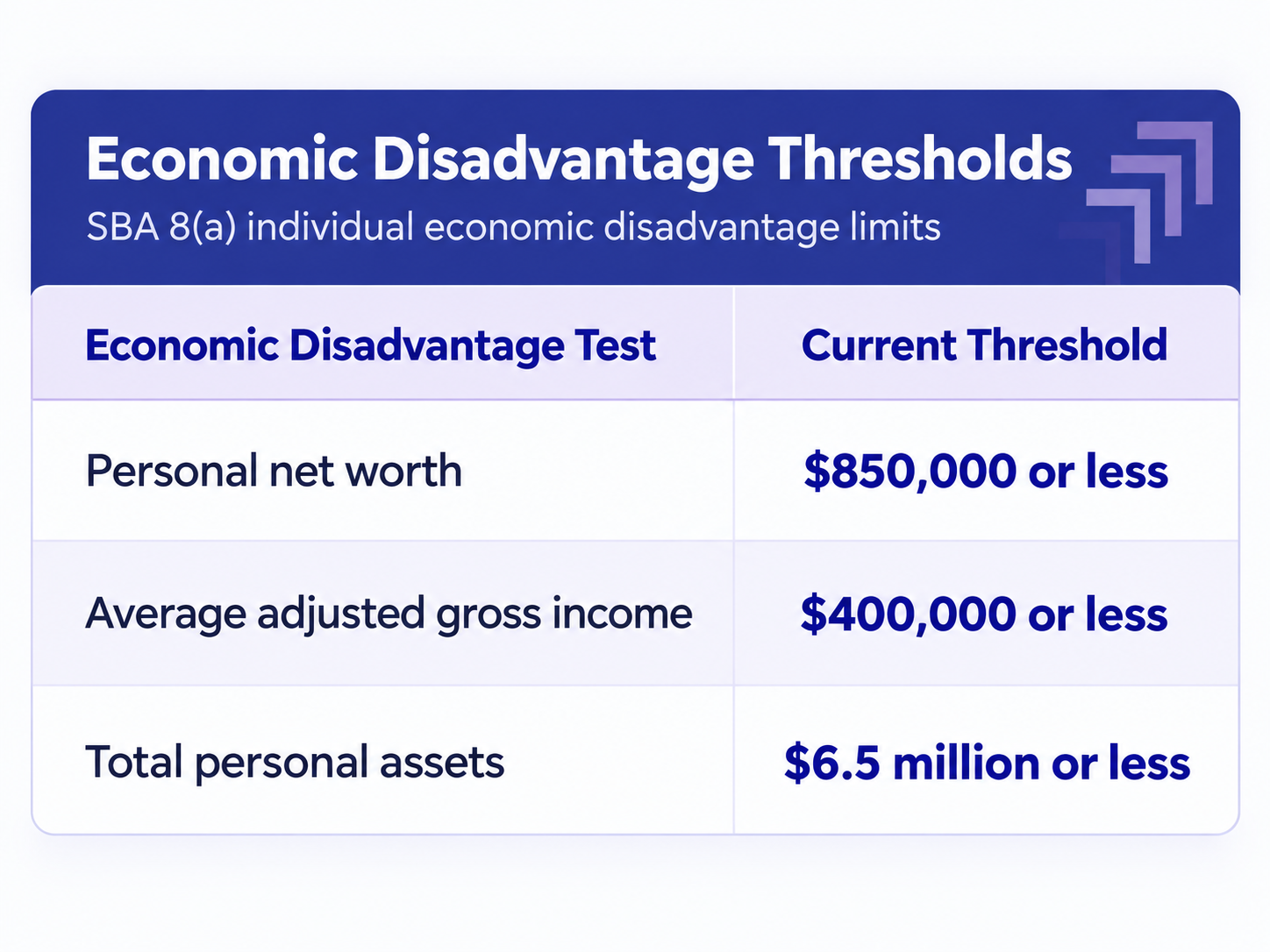
These thresholds remain part of the 8(a) eligibility analysis.
Businesses should not confuse the new social disadvantage standard with economic disadvantage.
They are separate eligibility requirements.
An applicant can potentially establish social disadvantage but still fail the economic disadvantage test.
SBA Removed Race and Ethnicity Questions From the Certification Information Collection
The final rule also addresses SBA Form 2413, the Unified Certification System information collection.
SBA states that the information collection was modified to remove questions concerning race and ethnicity.
That change is consistent with the broader shift away from using membership in specified racial or ethnic groups as a regulatory presumption of social disadvantage.
The application now turns more heavily on the factual evidence supporting the applicant's claim.
Defense Critical 8(a) Applicants Will Receive Priority Processing
SBA made another significant announcement on September 10.
The agency will prioritize 8(a) applications from businesses operating in ten defense critical NAICS codes as part of the federal government's effort to strengthen the defense industrial base.
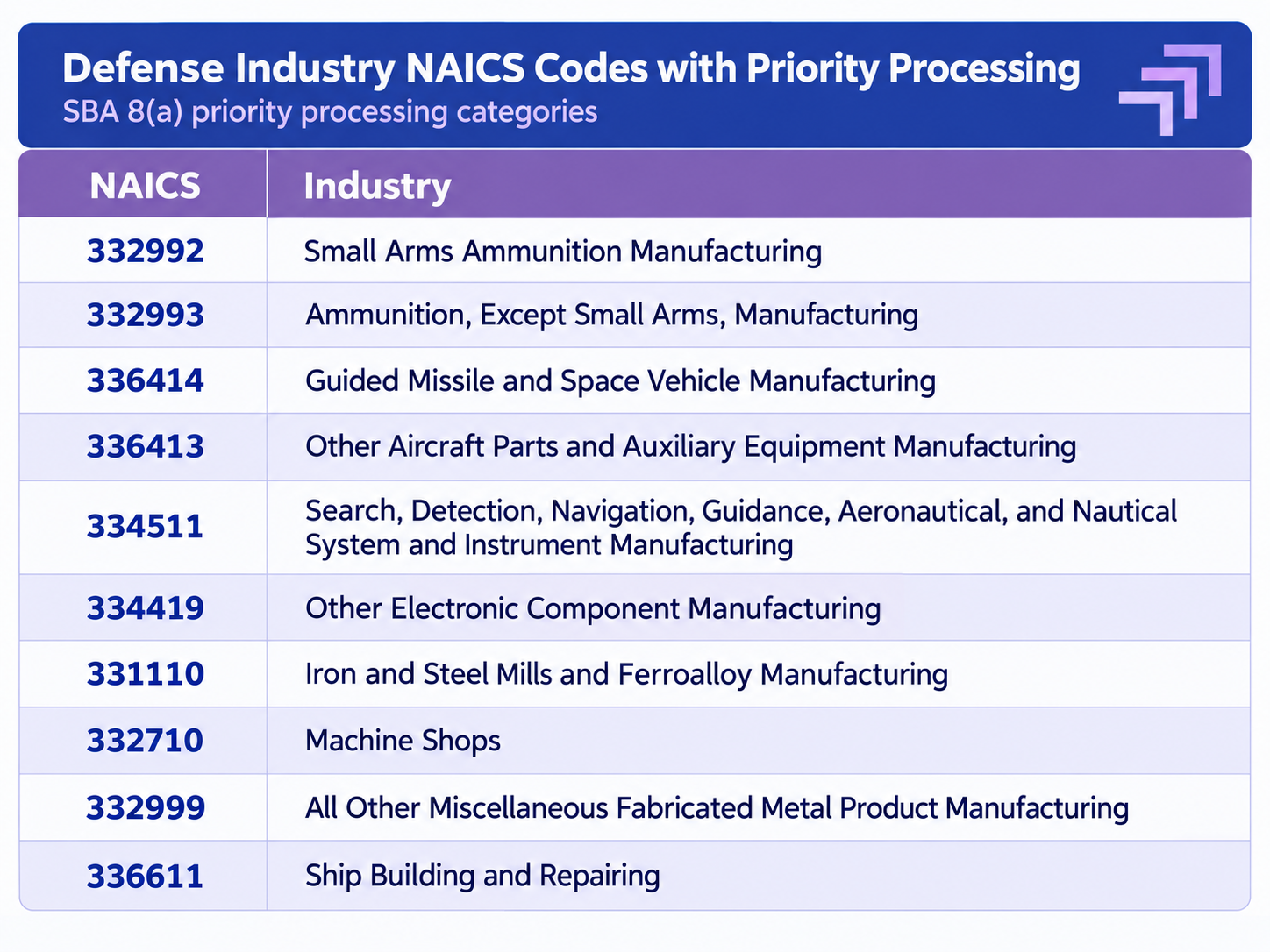
Priority processing does not appear to waive the underlying eligibility requirements.
A defense manufacturer must still satisfy the applicable ownership, control, social disadvantage, economic disadvantage, potential for success, size, and other requirements.
The difference is application priority.
For qualified defense suppliers, however, faster processing could make 8(a) certification substantially more valuable when aligned with an active federal capture strategy.
How Should Companies Prepare an 8(a) Application After September 10, 2026?
The application strategy should change.
Previously, much of the effort could focus on drafting and refining an owner's personal social disadvantage narrative.
That is no longer enough, and in many cases it is no longer the right starting point.
A stronger process begins with four separate analyses.
1. Establish the Social Disadvantage Theory
Determine exactly which identifiable group is involved, what governmental or private policy or action affected that group, when the conduct occurred, and why it potentially satisfies § 124.103.
Do this analysis before drafting conclusions.
2. Build the Evidence Record
Locate authoritative evidence supporting the existence of the discrimination, bias, favoritism, exclusion, or adverse treatment.
Strong evidence may include government records, statutes, regulations, court decisions, Congressional findings, institutional policies, archived documents, official investigations, audit reports, or similar records specifically contemplated by the regulation.
The goal should be to create an evidence chain that another reviewer can independently understand and verify.
3. Establish Individual Material Harm
Determine how the identified action or practice caused the qualifying owner to lose access to, or experience diminished opportunities related to, economic advancement.
The connection should be specific and credible.
The applicant should be able to explain:
Group → Policy or Practice → Applicant Membership → Economic Opportunity → Material Harm
That chain may become one of the most important components of a strong application.
4. Stress Test Potential for Success Before Submission
Before filing, review the company as if SBA were conducting an underwriting and responsibility review.
Examine the company's primary NAICS, operating history, federal and commercial contracts, tax returns, financial statements, working capital, technical capability, management experience, staffing, facilities, equipment, contract performance, and access to capital.
If the company needs a two year waiver, build that case before filing.
A Better 2026 8(a) Application Model
For companies preparing applications under the September 2026 rules, we recommend thinking about the application as four evidence files rather than one certification form.
File 1: Ownership and Control
Establish that the qualifying individual actually owns and controls the business under SBA's regulations.
File 2: Social and Economic Disadvantage
Build the objective group discrimination evidence, applicant certification, material harm connection, and economic disadvantage documentation.
File 3: Potential for Success
Demonstrate that the company is operationally capable, financially viable, technically qualified, appropriately managed, and positioned to perform federal work.
File 4: Federal Market Strategy
While not every element of a capture strategy is technically required for certification, a company should understand why it wants 8(a) status before using one of the owner's most valuable federal contracting assets.
The 8(a) Program lasts a maximum of nine years.
Certification should therefore be timed against actual market opportunity, agency demand, contract vehicles, recompetes, teaming relationships, sole source prospects, and the company's ability to pursue federal business.
Obtaining 8(a) certification without a strategy for using it can waste valuable program time.
Who Should Reconsider 8(a) Eligibility Under the New Rule?
The September 2026 rule means some business owners who previously dismissed the 8(a) Program should reconsider their eligibility.
That does not mean they will qualify.
It means the answer should now come from an analysis of the new regulation rather than assumptions based on the previous system.
That includes business owners who did not belong to one of the groups previously receiving the rebuttable presumption.
It may also include individuals affected by historical policies involving sex, disability, racial or ethnic classifications, educational access, government programs, employment practices, contracting preferences, financial access, or other circumstances that potentially satisfy the new regulatory framework.
The operative question is no longer simply:
"Do I belong to a presumed group?"
The better question is:
"Can I establish a qualifying group based discrimination or bias under 13 CFR § 124.103 and truthfully certify that it caused me material economic harm?"
That is a much broader and more fact specific inquiry.
What Has Not Changed in the 8(a) Program?
Despite the significance of the September 2026 changes, many foundational requirements remain.
Applicants still generally must be small under the applicable SBA size standard.
An individually owned applicant must generally be at least 51 percent unconditionally owned and controlled by socially and economically disadvantaged U.S. citizens.
Qualifying owners must satisfy the economic disadvantage requirements.
Applicants must demonstrate good character.
Applicants must demonstrate potential for success.
The business generally may not have previously participated in the 8(a) Program.
The qualifying individual may generally only use his or her individual program eligibility once.
And the maximum program participation period remains nine years.
The rule also does not reduce the value of 8(a) contracting itself.
The significance of this change is primarily who can establish social disadvantage and how SBA will evaluate applications.
What Should a Pending 8(a) Applicant Do Now?
If your application was pending on September 10, 2026, do not assume that the package submitted under the previous application framework remains sufficient.
SBA has announced that pending individually owned applications will be returned so applicants can conform their applications to the new standards and provide updated financial information. The agency is providing 45 calendar days for applicants to update and resubmit.
Use that opportunity strategically to:
Review the application from the beginning.
Determine whether the existing social disadvantage theory works under the new § 124.103 test.
Replace unsupported personal conclusions with authoritative evidence where appropriate.
Confirm the material harm connection.
Review financial information for accuracy and consistency.
Reevaluate the primary NAICS.
Test the company's operating history against § 124.107.
Determine whether a two year waiver is actually required.
And make sure the application tells one consistent story about ownership, control, experience, financial capability, contract performance, and federal market readiness.
What This Means for Federal Contractors
The September 10, 2026 changes represent more than a change in terminology.
They change the way prospective 8(a) applicants should think about certification.
The social disadvantage determination is becoming more evidence based.
Potential for success is receiving renewed emphasis.
Financial readiness matters.
Pending applications must be updated.
Defense manufacturers in specified NAICS codes may receive faster consideration.
And business owners who previously assumed they could not qualify may have legitimate reasons to revisit that conclusion.
For government contractors, the strategic question should therefore not simply be:
"Can we get 8(a) certified?"
It should be:
"Do we qualify under the new rules, can we prove it, and do we have a federal market strategy that makes using nine years of 8(a) eligibility worthwhile?"
That is the question that should drive an 8(a) decision in 2026.
Frequently Asked Questions About the September 2026 SBA 8(a) Changes
Did the SBA 8(a) rules change on September 10, 2026?
Yes. SBA's final rule revising 13 CFR § 124.103 became effective September 10, 2026. It eliminates the regulatory rebuttable presumption of social disadvantage for individually owned applicants and establishes a new evidence based social disadvantage test.
Is the 8(a) social disadvantage narrative still required?
The previous narrative based regulatory test has been replaced by the new § 124.103 framework. Applicants now establish social disadvantage through evidence of group discrimination or bias combined with the individual's self certification of group membership and resulting material harm.
Are minorities automatically considered socially disadvantaged for 8(a)?
No. The regulation no longer provides the previous rebuttable presumption based on membership in specified racial or ethnic groups. Individually owned applicants must satisfy the new social disadvantage standard.
Can a White business owner qualify for the 8(a) Program?
Potentially, yes. The revised regulation is not restricted to members of the previously presumed groups. The rule specifically recognizes prior versions of § 124.103 that excluded a citizen's group from the rebuttable presumption as potential evidence of group discrimination or bias. The individual must still meet the material harm and all other 8(a) eligibility requirements.
Can women qualify as socially disadvantaged under the new 8(a) rule?
Potentially. SBA specifically explains that discrimination or bias based on sex may qualify when the applicant satisfies the regulatory test. SBA uses historical restrictions on women's access to credit as one example. Membership in a sex alone does not create an automatic presumption.
Can disability support an 8(a) social disadvantage claim?
Potentially. SBA discusses Congressional findings associated with the Americans with Disabilities Act as an example of evidence that may establish group discrimination. The applicant must still satisfy the other requirements, including demonstrating the appropriate connection to material harm.
What is material harm under the new 8(a) rule?
13 CFR § 124.103 defines material harm as loss of access to or diminished opportunities related to economic advancement. SBA states that the definition is broader than the previous focus on entry into or advancement in the business world.
What happens to 8(a) applications that were pending before September 10?
The new rule applies to pending individually owned applications. SBA announced that pending applications will be temporarily returned through its Return to Business process. Applicants will have 45 calendar days to update and resubmit their applications.
Do currently certified 8(a) businesses have to prove social disadvantage again?
Generally, no. SBA states that social disadvantage has historically been a one time determination and that currently admitted participants do not need to reestablish social disadvantage solely because the new rule became effective.
Did the 8(a) economic disadvantage thresholds change?
No. SBA currently lists the individual economic disadvantage limits as personal net worth of $850,000 or less, three year average adjusted gross income of $400,000 or less, and total personal assets of $6.5 million or less.
Does an 8(a) applicant still need two years in business?
Generally, yes. Under 13 CFR § 124.107, an individually owned applicant normally must have operated and received contracts in its primary industry for at least two full years immediately before applying. SBA may waive the requirement when the applicant satisfies all applicable waiver conditions.
What is the 8(a) "potential for success" requirement?
Potential for success is SBA's determination that the applicant is capable of performing 8(a) contracts and has reasonable prospects for success. SBA may consider operating history, financial capacity, access to capital and credit, management experience, technical capability, and past contract performance. SBA announced renewed emphasis on this review on September 10, 2026.
Are some 8(a) applications being processed faster?
Yes. SBA announced priority processing for applicants in ten defense critical manufacturing NAICS codes covering industries such as ammunition, missiles and space vehicles, aircraft components, navigation systems, electronic components, steel, machine shops, fabricated metal products, and shipbuilding and repair.
Do the September 2026 social disadvantage changes apply to tribal or other entity owned 8(a) businesses?
No. The final rule does not change the social disadvantage requirements for businesses owned by Indian tribes, Alaska Native Corporations, Native Hawaiian Organizations, or Community Development Corporations.
Primary Sources and Regulatory References
This analysis is based primarily on the following authorities and SBA guidance current as of September 10, 2026:
SBA Final Rule, 91 FR 51568, published August 11, 2026 and effective September 10, 2026: Reforms to 13 CFR 124.103 concerning the rebuttable presumption and revised standards for establishing social disadvantage.
SBA News Release 26-90, September 10, 2026: SBA guidance concerning defense critical application prioritization, potential for success reviews, pending applications, and the 45 day resubmission period.
MySBA Certifications, September 10, 2026: SBA published Social Disadvantage Regulation Change FAQ Volume Two and a separate Potential for Success FAQ on the effective date of the new rule.
13 CFR § 124.103: Social disadvantage requirements.
13 CFR § 124.104: Economic disadvantage requirements.
13 CFR § 124.107: Potential for success and the two year operating requirement.
About Squared Compass
Squared Compass helps businesses navigate the federal, state, local, and international government contracting markets through capture strategy, proposal development, market intelligence, contract vehicle strategy, certifications, compliance support, and business development advisory services.
Schedule time with us to chat.
This article is provided for informational and business advisory purposes and should not be interpreted as legal advice. SBA regulations, guidance, certification procedures, and interpretations can change. Applicants should evaluate the current regulation and SBA guidance applicable at the time of submission.