GSA's New AI Rules Take Effect October 19: Which Government Contractors Must Comply?
New federal AI contracting requirements could affect software providers, cybersecurity companies, prime contractors, and subcontractors. But not every business using artificial intelligence is covered.
The General Services Administration (GSA) has introduced new artificial intelligence contracting requirements that take effect on October 19, 2026. The new clause, GSAR 552.239-7001, establishes rules for safeguarding government data processed by large language model (LLM) artificial intelligence systems.
For federal contractors, the implications extend beyond cybersecurity. The requirements address government data ownership, AI model training, security incident reporting, subcontractor obligations, system transparency, and potential contract termination.
However, there is an important distinction that contractors should understand before investing in compliance:
Two companies could provide nearly identical technology services to the federal government, yet only one might be subject to the new GSA AI clause.
Whether the clause applies depends on the technology being purchased, how the government uses the AI system, whether government data is processed, and the contractor's role in delivering the solution.
Here's what government contractors need to know.
What Is GSA's New AI Contract Clause, GSAR 552.239-7001?
GSAR 552.239-7001 is titled Basic Safeguarding of Data within Large Language Model Artificial Intelligence Systems.
GSA issued the clause through class deviation RGO-2026-01 in September 2026 as part of its broader acquisition regulation overhaul.
The clause establishes contractual requirements for government purchases of large language model systems, including:
Generative AI assistants and chatbots
AI agents and agentic systems
LLM-powered document analysis platforms
AI-enabled productivity tools
Other systems where LLM functionality is a material part of what the government is purchasing
The regulation addresses how government data is collected, processed, stored, protected, and ultimately deleted.
It also establishes requirements surrounding subcontractors, AI model changes, reporting, and government oversight.
Importantly, this is a contractual requirement, not a blanket regulation covering every company that uses artificial intelligence.
GSA's official acquisition guidance establishes October 19, 2026, as the effective date for Part 552, which contains the new clause. Contracting officers may incorporate the requirements earlier and have discretion regarding existing contracts.
That means an existing federal contractor does not automatically become subject to GSAR 552.239-7001 simply because October 19 arrives.
Official source: GSA RGO-2026-01, including GSAR 539.71 and 552.239-7001
Who Must Comply With the New GSA AI Rules?
The clause establishes two central conditions for applicability:
Material AI functionality: The government is purchasing a system where large language model functionality is a material feature of the product or service.
Government data processing: Government data will be submitted directly to or produced by that LLM.
Both conditions matter.
A software company does not automatically become covered because it uses machine learning, automation, predictive analytics, or an internal generative AI tool.
Likewise, a company providing an LLM-powered system to the government should not assume it is exempt simply because the software is commercially available.
The Two Important Exclusions
GSAR 552.239-7001 contains self-deleting provisions for certain uses, unless otherwise identified by the contracting officer.
1. Internal contractor AI tools
The clause generally excludes LLMs used only for internal business, operational, administrative, or contract performance support when those systems are not delivered to or accessed by the government.
For example, a consulting firm using an internal AI assistant to organize research or support document preparation would generally fall outside this particular clause.
Other federal contract terms, confidentiality restrictions, and information security requirements may still apply to that use.
2. Incidental AI functionality
The clause also addresses products or services where LLM functionality is incidental to the primary purpose of the procurement.
Consider a commercial software platform that performs its main functions without AI but includes a small optional generative AI feature.
If the feature is not required by the contract, accessed by the government, or used to process government data, the exclusion may apply.
Because specific contract language and technical functionality matter, contractors should document their applicability determinations rather than assuming an exemption.
Five Examples: How the Same Cybersecurity Company Could Be Treated Differently
Consider a fictional cybersecurity software company providing technology solutions to federal agencies.
Depending on how that company delivers its services, the new GSA AI requirements may or may not apply.
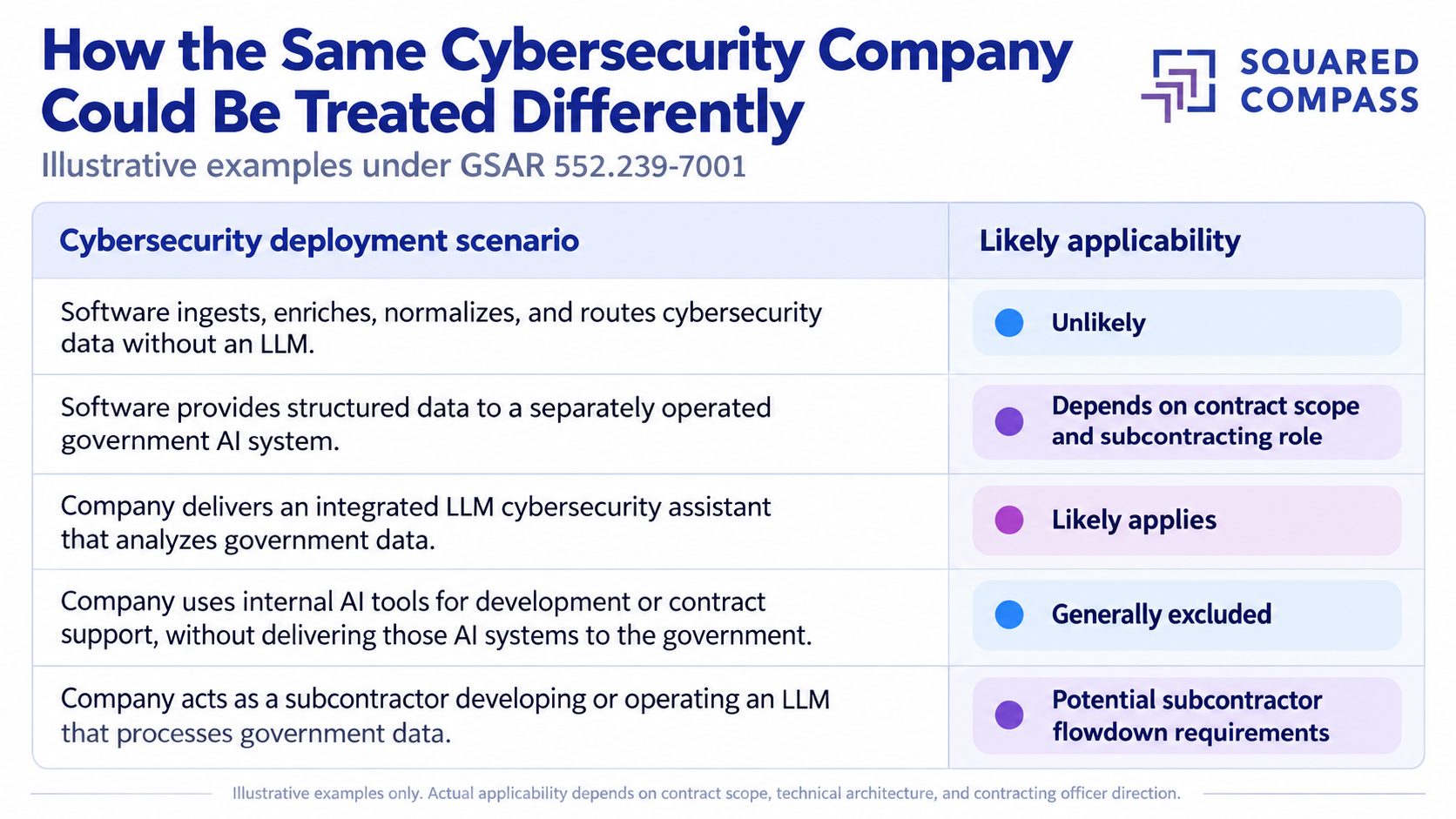
These examples are illustrative, not final legal determinations. Actual applicability depends on the contract, technical architecture, and contracting officer's direction.
Why the Third Scenario Matters
Suppose the cybersecurity company develops an LLM-powered assistant that allows federal employees to ask:
"What suspicious activity occurred on our network overnight?"
The assistant examines government cybersecurity records, identifies anomalies, and generates recommendations.
In this scenario, the government is purchasing an AI system where LLM functionality is central to the service.
Government data is also being processed by that LLM.
Consequently, GSAR 552.239-7001 would likely apply when incorporated into the relevant procurement.
By contrast, a cybersecurity platform performing similar analysis through traditional rules-based software without an LLM would generally not trigger this particular clause.
The difference is not simply what the software accomplishes. It is how the functionality is delivered, how the AI is used, and what the contract requires.
What Are the Biggest Changes for Government AI Contractors?
1. Restrictions on Training AI Models With Government Data
One of the most consequential provisions restricts contractors from using government data to train, fine-tune, or otherwise improve LLMs outside the permitted purposes of contract performance.
Imagine a federal agency uploads thousands of cybersecurity incident reports to a contractor's AI platform.
The contractor cannot simply take those reports and use them to improve its commercial AI model for unrelated customers.
The restriction also covers unauthorized use of government data for marketing, sales, monetization, and other business purposes.
The clause does permit limited uses necessary to fulfill the contract, as well as certain narrowly defined uses of de-identified, aggregated security telemetry for cybersecurity and threat detection.
For companies developing AI products across multiple government and commercial customers, this requires close attention to data separation, model improvement practices, and vendor agreements.
Contractors should also distinguish between their pre-existing intellectual property and developments specifically created for the government.
The clause protects ownership of underlying models and contractor background intellectual property while assigning government rights to covered government data and custom developments.
Whether contract-specific model customization or fine-tuning is permissible should be examined carefully under the precise contract requirements.
2. New Security Incident Reporting Requirements
The clause contains two distinct 72-hour reporting obligations.
First, contractors must notify the contracting officer within 72 hours after obtaining actual knowledge of a material violation of the clause.
Second, certain security incidents affecting the LLM and potentially compromising government data must be reported as soon as possible, but no later than 72 hours after discovery.
Qualifying incidents also trigger additional obligations, including ongoing updates, incident reporting procedures, and preservation of relevant investigative records.
Contractors must preserve relevant logs, forensic images, and incident artifacts for at least 90 calendar days.
For AI service providers, these requirements have direct implications for security monitoring, incident response procedures, and the responsibilities of cloud and model infrastructure providers.
3. Advance Notice of Certain AI Model Changes
Many commercial AI platforms update their models frequently.
New model versions may introduce improved capabilities, change accuracy, modify safety mechanisms, or replace underlying providers.
Under the GSA clause, certain changes require written notice to the contracting officer at least 30 calendar days in advance.
These can include adding or replacing an LLM, materially changing a model or service provider, or making significant changes to services handling government data.
The clause also contains special procedures for model deprecation, third-party provider changes, emergencies, and changes that materially affect accuracy or safety.
For contractors relying on third-party AI models, understanding the provider's update and notification policies becomes part of contract management.
4. Government Data Ownership, Portability, and Deletion
The government retains ownership of government data and covered custom developments.
Contractors must implement safeguards addressing unauthorized access, data separation, storage, and processing.
The clause also addresses where government data may be accessed or processed and places restrictions on moving it outside agreed locations or authorized services without appropriate written consent.
Importantly, the contractor must support government data export and migration using appropriate machine-readable formats.
Upon contract completion, termination, or expiration, the contractor generally must securely delete government data and covered custom developments, including relevant copies, backups, embeddings, indexes, and caches, unless directed otherwise in writing.
This is particularly important for companies relying on external cloud hosting, model providers, or data processing subcontractors.
Can Subcontractors Be Required to Comply?
Yes. A subcontractor can face requirements under the GSA AI clause even when it does not hold the prime contract with the government.
This occurs through what government contracting professionals call a flowdown clause.
A flowdown is a contractual requirement that the prime contractor must pass to applicable subcontractors.
Under GSAR 552.239-7001, relevant obligations must be flowed down to subcontractors performing certain AI design, development, deployment, or operation and monitoring tasks involving government data.
Consider a prime contractor selling an AI cybersecurity platform to a federal agency.
The prime hires another company to build the LLM's data processing functionality.
Even though the subcontractor has no direct contract with GSA, the prime may need to incorporate applicable AI safeguarding obligations into its subcontract.
Not every subcontractor automatically receives every provision. The required flowdowns depend on the subcontractor's activities and treatment of government data.
For prime contractors, that makes supplier agreements, subcontract documentation, and due diligence particularly important.
For subcontractors, the lesson is straightforward: Do not assume a requirement is irrelevant simply because your company does not contract directly with the government.
Key Compliance Deadlines Under GSAR 552.239-7001
Several of the clause's deadlines begin when a particular event occurs, not on October 19.
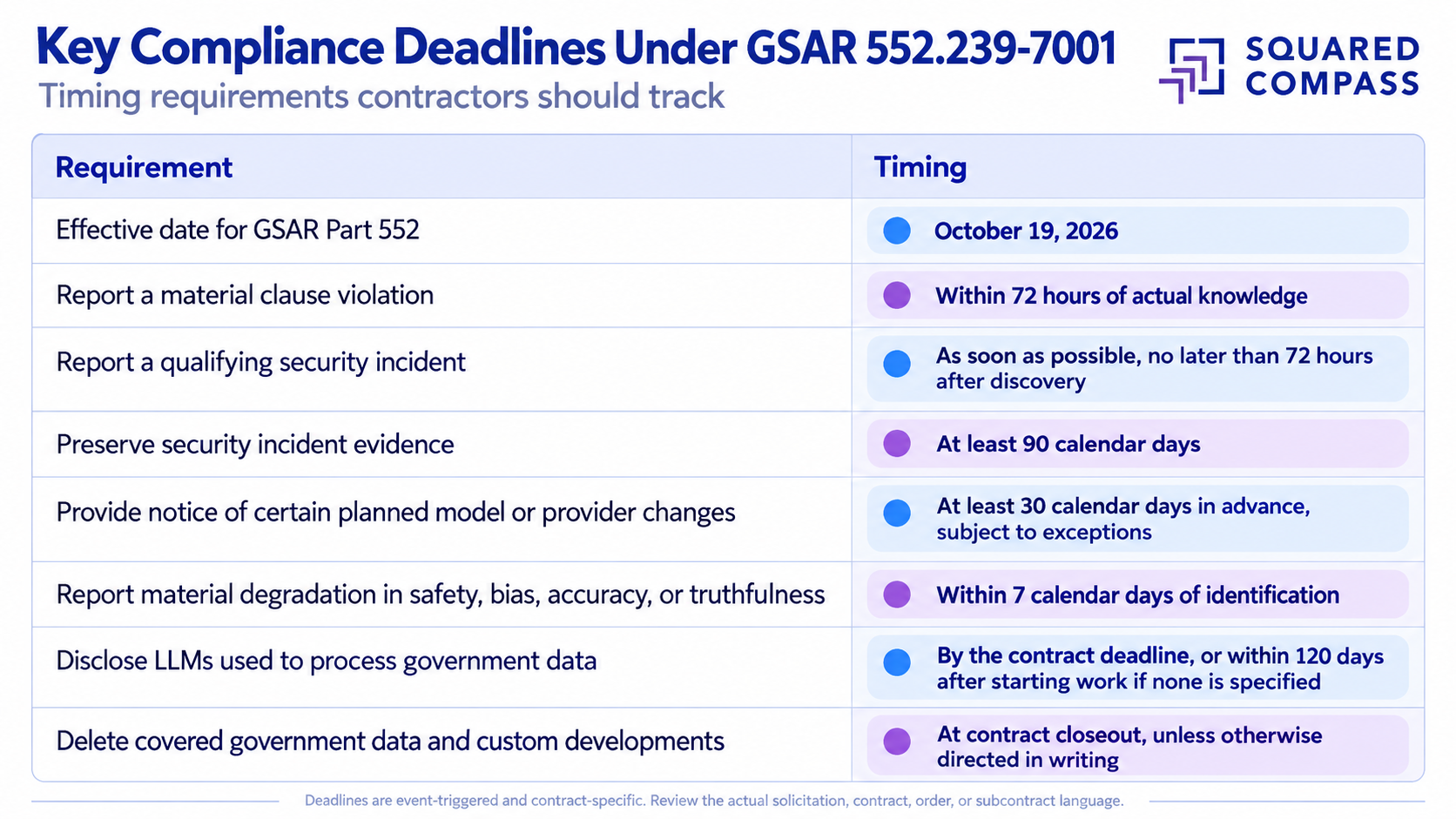
October 19 is not a universal deadline for every existing government contractor to demonstrate compliance.
The critical question is whether the clause has been incorporated into the contractor's applicable solicitation, contract, task order, delivery order, blanket purchase agreement, or subcontract.
What Happens if a Contractor Violates the GSA AI Clause?
The consequences can extend beyond additional compliance paperwork.
Under the clause, the government retains the right to suspend use of the LLM at any time.
For companies whose government revenue depends on continued operation of an AI platform, a suspension could create significant operational and financial consequences.
The clause also provides for certain decommissioning costs following termination for cause when a contractor fails to remediate after receiving specific written notice.
Those qualifying decommissioning costs are capped at 25% of the value of the affected task or delivery order and exclude certain unrelated replacement and reprocurement costs.
That limit should not be mistaken for an overall cap on every potential form of contractual liability.
The financial exposure associated with noncompliance will depend on the relevant contract, the nature of the violation, and available remedies.
What Should Government Contractors Do Now?
For businesses selling AI-enabled technology to federal agencies, Squared Compass recommends beginning with an applicability assessment rather than immediately investing in new compliance systems.
Step 1: Identify the AI capabilities being delivered.
Determine whether the government is purchasing an LLM-enabled system or whether AI is simply an internal tool used to support performance.
Step 2: Map the flow of government data.
Identify where government data enters the system, which models process it, where it is stored, and which third parties can access it.
Step 3: Review prime contracts and subcontracts.
Look for GSAR 552.239-7001, related requirements, and any applicable flowdown obligations.
Step 4: Review AI provider agreements.
Understand the model provider's policies concerning government data, training, retention, incident reporting, and model updates.
Step 5: Assess operational readiness.
Confirm that the organization has appropriate security monitoring, data deletion capabilities, documentation, reporting procedures, and contract administration controls.
Step 6: Seek contracting officer clarification when necessary.
If applicability is unclear, request clarification based on the actual scope of work and technical solution.
Contractors should also monitor applicable GSA contract updates, solicitations, and modifications as implementation continues.
Frequently Asked Questions About GSA's 2026 AI Rules
When do GSA's new AI rules take effect?
GSAR Part 552, containing the new AI clause, has an effective date of October 19, 2026. Contracting officers may implement changes earlier and have discretion regarding open solicitations and existing contracts.
Do the new GSA AI rules apply to every government contractor?
No. The clause focuses on procurements where LLM functionality is a material feature and government data is submitted directly to or produced by the LLM. It does not automatically cover every contractor using AI.
Does using ChatGPT internally trigger GSAR 552.239-7001?
Generally, internal business or performance-support use that is not delivered to or accessed by the government is excluded from this particular clause, unless the contracting officer identifies otherwise. Other contractual data protection rules may still apply.
Does the clause apply to traditional cybersecurity software?
Not necessarily. A cybersecurity platform that does not use an LLM would generally fall outside the specific LLM procurement requirements of GSAR 552.239-7001.
Can government contractors use government data to train their AI models?
The clause restricts training, fine-tuning, and other model improvements using government data beyond its expressly permitted purposes. Contractors should obtain clarification before undertaking any ambiguous, government-specific model training activity.
Do the GSA AI requirements apply to subcontractors?
They can. Applicable provisions must be flowed down to certain subcontractors performing AI design, development, deployment, or operation and monitoring functions involving government data.
Does GSAR 552.239-7001 apply to GSA Schedule contracts?
It can apply to relevant procurements through GSA contracting vehicles. Contractors should examine their actual Schedule contract, solicitation, order, and any applicable modification rather than assuming every existing Schedule contract automatically contains the clause.
What is the biggest compliance risk?
For an AI provider, one of the most consequential risks is using government data in ways the contract does not permit, including unauthorized model improvement. Incident reporting failures, data handling problems, and missed subcontractor obligations create additional exposure.
The Bigger Picture: Federal AI Contracting Is Becoming More Defined
The federal government continues to explore AI for cybersecurity, document analysis, administrative processes, and operational decision support.
GSA's new AI clause reflects an effort to establish clearer contractual protections for government information when agencies acquire large language model systems.
For contractors, the challenge is not simply understanding how an AI model works.
It is understanding how that model fits into a government acquisition, which organizations are responsible for its operation, who controls the data, and which requirements apply.
The distinction between delivering AI to the government and using AI internally is particularly important.
Companies should evaluate their actual contract responsibilities rather than assuming that all AI use creates the same regulatory obligations.
The bottom line: GSA's new AI clause could materially affect federal AI contractors, but understanding whether it applies is the first and most important compliance decision.
How Squared Compass Can Help
Squared Compass works with companies navigating federal procurement requirements, contract opportunities, and government market entry.
As federal agencies expand their use of artificial intelligence, contractors need to align their technology capabilities, proposal strategies, subcontracting arrangements, and contract performance obligations with evolving acquisition requirements.
Whether your company develops AI solutions, provides cybersecurity services, or supports federal agencies as a prime contractor or subcontractor, understanding the procurement implications of GSAR 552.239-7001 is an important starting point.
Visit Squared Compass to learn more about our government contracting advisory services.
Official Sources and Further Reading
General Services Administration. RGO-2026-01: Revolutionary GSAR Overhaul Class Deviations. Primary source for GSAR 539.71 and clause 552.239-7001, September 2026 deviation text.
Acquisition.gov. Revolutionary GSAR Overhaul. Official resource for GSAR deviation documents and updates.
Federal Register, June 17, 2026. General Services Acquisition Regulation: Acquisition of Information and Communication Technology. Earlier proposal and public comment notice, provided for regulatory history rather than as the operative October clause.
Crowell & Moring, October 2, 2026. GSA Issues Final Rule on Large Language Model Procurements. Independent legal analysis discussing changes from the proposed clause.
This article provides procurement research and general information, not legal advice. Contract specific interpretations should be confirmed with the relevant contracting officer and qualified legal counsel.